RoDTEP: why India returns tax costs to exporters
A proposed renewal raises a practical question: what relief can a business count on when pricing its next overseas order?
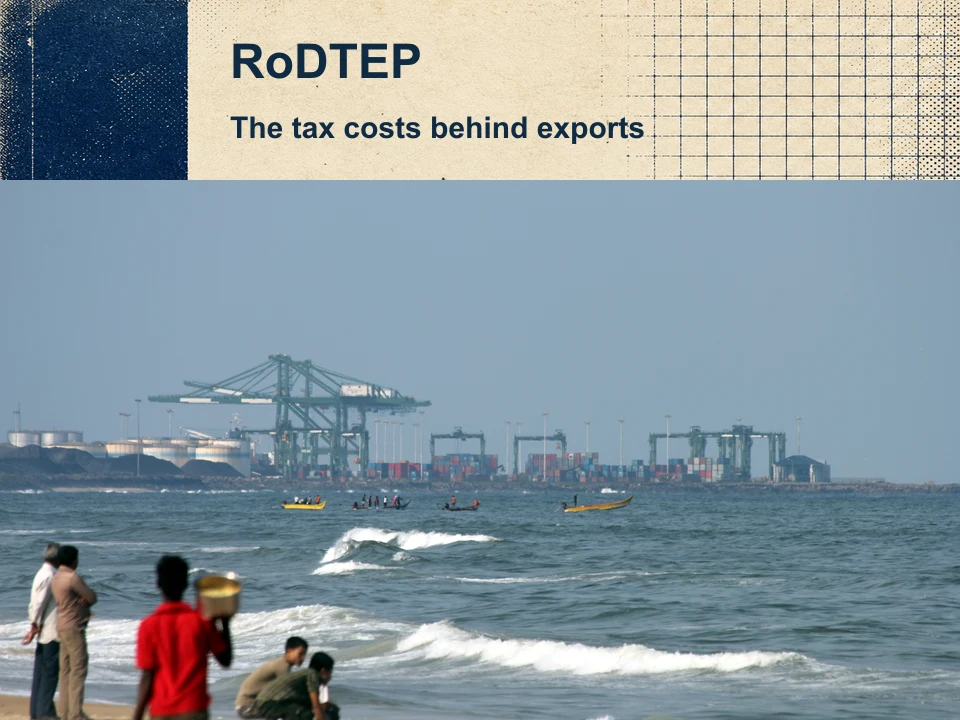

An Indian exporter can sell goods abroad without charging Indian GST and still carry Indian taxes in the cost of making and moving them. Electricity duty at the factory or tax on a truck’s fuel can remain inside the price. RoDTEP is meant to return eligible taxes that other refund systems leave behind.
The scheme now faces a renewal decision. On 16 September 2026, Moneycontrol reported, citing government officials, that the Commerce Ministry had sought more funding and proposed continuing RoDTEP for five years. The report said expenditure appraisal was still pending. The existing DGFT notification covers eligible exports from 1 April through 30 September 2026.
A business quoting today for an order it will ship later needs to know what tax relief it can count on. That depends on how long the scheme runs, the rate for its product and how it can use the credit it receives.
Why taxes remain inside an export price
Imagine a small manufacturer selling metal fittings to an overseas buyer. Its costs include materials, electricity, labour and transport to the port. Some taxes on those purchases can be recovered through existing arrangements. Others remain a cost to the business even though the finished goods are sold abroad.
When the government approved RoDTEP in March 2020, it identified gaps such as electricity duty used in manufacturing, VAT on transport fuel and mandi taxes, which are levies associated with agricultural markets. The principle was to relieve exports of domestic taxes that had not already been refunded. RoDTEP stands for Remission of Duties and Taxes on Exported Products; remission here means returning eligible tax costs.
The intended benefit is a more competitive export price. A manufacturer that must recover an unrefunded tax through its selling price has to include that cost in its overseas quotation. Returning it gives the business more room to lower the quote or retain earnings on an order. Which happens depends on the price it negotiates with its buyer.
How the refund amount is decided
RoDTEP works through notified product rates and, where specified, a maximum amount per unit. There is no single percentage for every Indian export. The current extension refers to the rate lists in Appendix 4R and Appendix 4RE. Exporters need the entry that matches their product and export category.
The calculation generally applies the notified percentage to the export’s FOB value—the value of the goods at shipment, excluding overseas freight and insurance—subject to the applicable cap and valuation rules. A cap limits how much can be claimed per unit even when the percentage calculation would produce more. The exporter therefore needs the relevant product entry, rather than a headline about the scheme’s total budget.
Some exports fall under a different scheme. Apparel and made-up textiles have a separate scheme, RoSCTL, while other eligible textile products use RoDTEP, as the Textiles Ministry explained in April 2026. The purpose is to reimburse taxes left unrecovered, so the same tax cannot be refunded twice through different schemes.
The exporter receives a duty credit
The benefit arrives as an electronic duty-credit scrip, a transferable credit recorded in the customs system. Its holder can use it to pay Basic Customs Duty when importing goods. An exporter with no suitable import bill can transfer the credit to another eligible holder who can use it.
The ICEGATE customs guidance explains the sequence: the exporter claims the benefit in the shipping bill, the customs declaration for the goods. After the export manifest recording their departure is filed, Customs processes the claim and makes the approved amount available for generating a scrip.
The business therefore pays its production costs and ships the goods before obtaining a usable credit. That credit cannot directly pay wages or a supplier. Using it saves customs duty; selling it requires a buyer and an agreed price. Its face value alone therefore does not tell us how much cash reaches the exporter or when.
Why the budget matters to an overseas order
A manufacturer may agree a selling price before it buys materials and ships the finished order. Suppose it allows for an expected tax rebate when deciding the lowest price it can accept. If the applicable rebate later falls, the business has less left from that fixed-price sale. If the rebate continues, the original calculation is easier to sustain.
RoDTEP also has to fit the government’s approved budget. A DGFT notification from March 2024 explicitly provided for schedule changes to keep spending within that budget. Extending the scheme for several years and allocating money to it each year are separate decisions.
There is a recent example of rates changing. On 23 March 2026, the Commerce Ministry restored earlier RoDTEP rates and caps after a February restriction had reduced them by half. It cited disruption to shipping routes and higher logistics costs linked to West Asia. The measure supported exporters facing those pressures; the scheme still reimbursed eligible taxes rather than the whole increase in their freight bill.
More relief lowers the tax costs exporters must recover, while using government funds. Whether that produces additional orders depends on demand, competing suppliers, delivery reliability and the prices businesses actually offer. The renewal announcement alone would not establish an increase in exports or jobs.
What to look for in a renewal
The next useful document is the final notification: which shipment dates it covers, which products and exporter categories qualify, and whether rates or caps change. Those details determine the relief available on an order. The approved annual allocation shows the resources behind the scheme.
For now, the five-year proposal reported on 16 September remains a proposal; the notified endpoint is September 30. For the manufacturer pricing an October shipment, the decisive information will be the rules that cover that shipment—and how and when the resulting credit can be used.