How soil-carbon credits become a payment to Indian farmers
Punjab and Haryana farmers are receiving carbon payments for earlier farming changes. Measurement, credit sales and contract terms determine how that work becomes income.
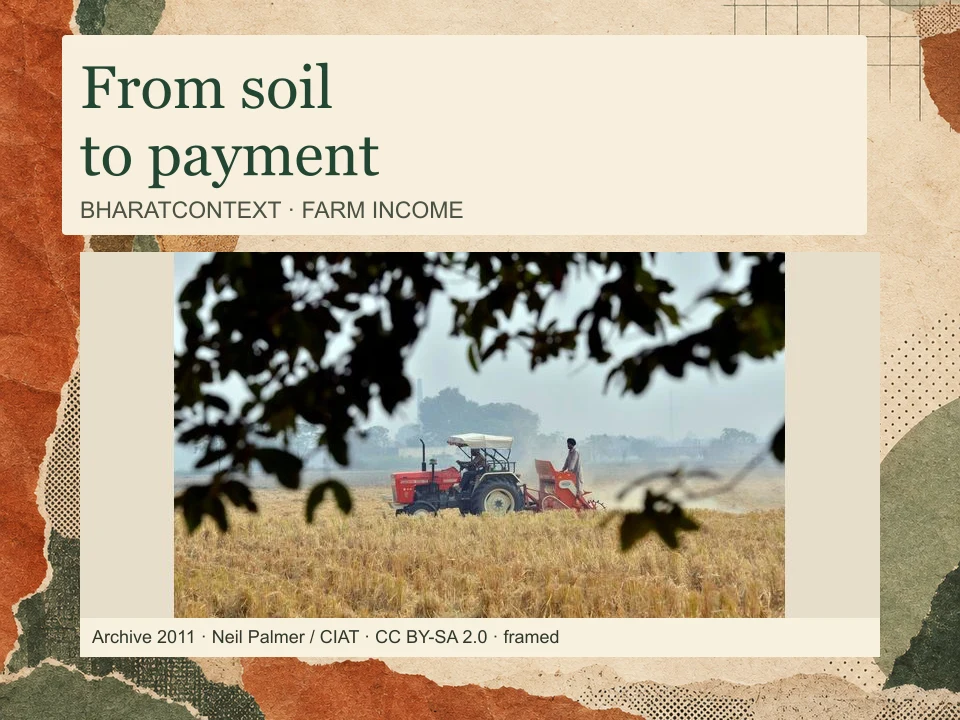

Farmers usually get paid for something that leaves the field: grain, vegetables, cotton. A new payment in Punjab and Haryana rewards changes in farming that store carbon in the soil or reduce greenhouse-gas emissions.
On 17 September 2026, the agriculture ministry reported the start of soil-carbon payments under Grow Indigo’s Aadi programme. More than ₹2.9 crore is to be disbursed to 2,550 farmers. Participating farmers received approximately ₹3,000–₹15,000, according to the ministry’s account.
Turning those changes into income takes several steps. A project developer must measure the climate benefit, have it independently checked and obtain carbon credits that can be sold. The farmer’s contract determines how and when they receive a share of the money.
What is the farmer being paid for?
Plants take carbon dioxide from the air as they grow. Roots and crop residues can return some of that carbon to the soil. Agricultural practices influence how much remains there, while irrigation, fertiliser and other decisions also affect greenhouse-gas emissions.
A carbon project compares the outcome under changed practices with an estimate of what would have happened without the project. It seeks credit for the additional climate benefit, rather than paying for all the carbon already in the field. A carbon credit conventionally represents one tonne of carbon-dioxide-equivalent reduced or removed; that common unit lets the climate effects of different greenhouse gases be compared. A buyer can retire a credit—take it out of circulation—to count its claimed climate benefit against emissions elsewhere.
Verra’s VM0042 agricultural methodology covers both emission reductions and soil-carbon removals. Eligible practices include changes to tillage, fertiliser use, crop residues and water management. A “soil-carbon payment” can therefore reward both carbon stored in the soil and emissions avoided through farming. The farmer still grows and sells crops; the carbon programme adds a potential payment for this separately assessed climate benefit.
Why the first payment comes years after the work
Aadi’s first credited monitoring period covered farming practices during 2019–2022. In January 2026, Grow Indigo announced credit issuance covering around 30,000 acres and more than 50,000 credits. The September announcement described farmers receiving money years after the farming practices were monitored and months after credits were issued. The first payment therefore cannot be read as an annual income figure or a reward solely for this year’s crop.
- 2019–2022: practices in the first monitoring period.
- January 2026: Grow Indigo announces the first credit issuance.
- September 2026: the ministry reports the start of farmer payments.
Sources: the agriculture ministry and Grow Indigo announcements linked above. Milestones, not an annual payment schedule.
The process takes time because the developer must assemble evidence across fields, calculate the claimed climate benefit and take it through independent verification and review by the organisation that registers the credits. In a January interview, Grow Indigo’s executives described several review cycles involving remote sensing, crop models, farmer meetings and legal checks. Even after credits have been issued, the developer must find buyers to turn them into revenue.
The wait matters for a farmer’s budget. A farmer may have to change how a field is managed before knowing the final carbon payment. Equipment, labour, water and crop income still determine whether the change works for the farm in the meantime.
Who pays before a buyer arrives?
For this first round, the ministry says Grow Indigo advanced money from its own funds before all the credits were sold. Farmers could choose an assured upfront payment or 75% of net carbon revenue after sale. With an advance, the farmer can receive money while the company waits for buyers.
“Net” means the share is calculated after deductions. To understand what 75% is worth, a farmer needs the contract to explain which costs are deducted, how sale proceeds are allocated and when payment becomes due. Choosing between the two options means weighing an assured payment now against a payment that depends on the eventual sale.
The announced payout does not establish a standard rate per acre. Dividing total credits by total acreage cannot tell an individual farmer what they will receive either: fields, practices, credited outcomes and contractual allocations can differ.
A credible payment needs a credible climate claim
Measuring soil carbon is demanding. Soil varies within a field, and the estimate of how much carbon it held at the start affects the apparent gain. A 2024 study of carbon-accounting protocols found substantial differences in sampling and modelling requirements. Some protocols relied on regional estimates rather than direct soil analysis for the amount of carbon present at the start. That study is a warning about measurement quality across the market, not an audit of Aadi.
There is also the question of how long the benefit lasts. Carbon stored in soil can be released again. The UN Food and Agriculture Organization’s (FAO) 2026 review of permanence explains why climate accounting must consider both how long carbon stays stored and whether farmers sustain the practices. A payment today therefore raises a longer-term question: who must maintain the practice, monitor the outcome and respond if stored carbon is lost?
Good soil management can still have value beyond a tradable credit. FAO’s soil-carbon programme connects soil organic carbon with soil health, farm resilience and productivity. Those benefits deserve assessment alongside the cash payment, rather than being assumed for every field.
What would make this useful at scale?
For these payments to become a dependable source of additional income, farmers need to know how long they will wait between monitoring and payment, what costs will be deducted, and how to challenge a payment calculation.
Grow Indigo has a published transparency and grievance policy. In any carbon programme, the enrolment agreement and the calculation behind an individual payment should make the farmer’s continuing obligations clear. A farmer needs to know who bears crop and implementation costs, what happens if credits sell slowly, and what changing or leaving the agreement involves.
For public policy, the test is whether reliable measurement and clear contracts make participation practical for small farms. Bigger enrolment numbers alone cannot answer that. Farmers need payments they can understand and rely on, and farming changes that remain worthwhile between payments.