Who decides electricity tariffs in India?
A distribution company proposes household charges; the regulator for that area issues the tariff order. A state-funded subsidy can separately lower an eligible customer’s bill.

Who Decides?
When the price on an electricity bill changes, who approved it? For a household connected to a distribution company, the answer is normally the electricity regulator for its state or territory. The company delivers electricity, proposes the charges and sends the bill. The regulator examines the proposal and issues the tariff order. A state government may separately fund a subsidy that reduces what eligible customers owe. The Electricity Act, 2003 gives these actors different powers in sections 62, 64, 65 and 86.
How does a proposed rate become a tariff?
A distribution company, often called a discom, buys power and delivers it to customers in its licensed area. It files a tariff application that sets out the charges it wants to recover. The regulator considers costs, consumer interests and the rules governing tariff design. The Ministry of Power says state commissions consider power-purchase, transmission, network and supply costs when determining retail tariffs. A company’s application is therefore a request, not the rate customers must automatically pay.
Under section 64 of the Act, the applicant must publish an abridged version of its proposal. The commission considers suggestions and objections from the public before making an order; it can accept the application with changes or reject it with reasons. Consumers and other affected people can therefore question the filing’s assumptions before the order is made. For example, the Maharashtra Electricity Regulatory Commission published an invitation for objections on MSEDCL’s multiyear tariff petition in January 2025. This illustrates the public-objection step; the 2025 petition is not a current tariff schedule.
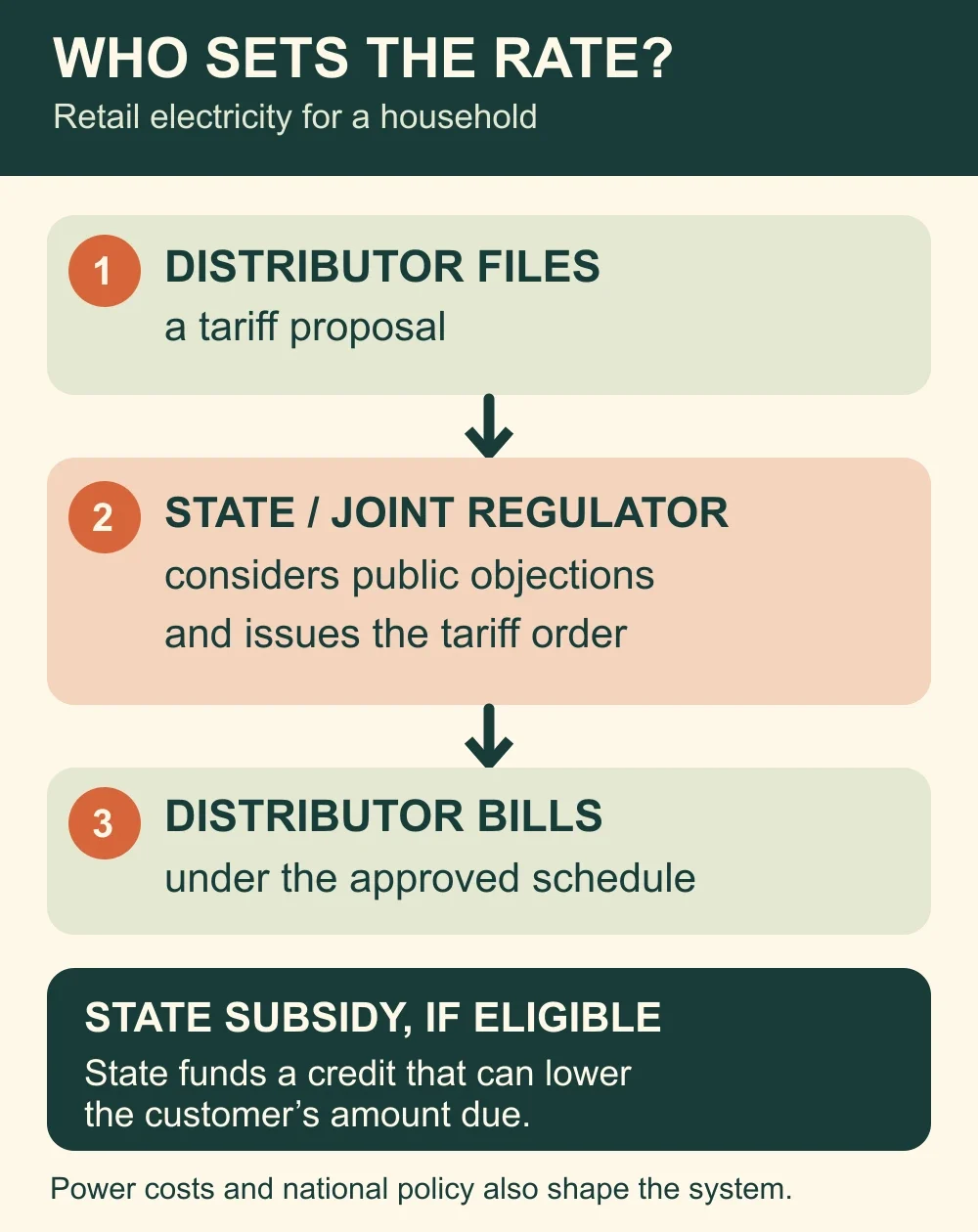
The retail tariff path under sections 62, 64, 65 and 86 of the Electricity Act. The company proposes, the regulator orders, and a state subsidy can separately reduce an eligible customer’s payable amount. Diagram: BharatQuests.
The regulator for your area may be a state commission or a joint commission covering more than one territory. JERC, for instance, regulates retail tariffs for Goa and several union territories; Delhi has its own commission. Your applicable order depends on your distribution area and customer category, not on a single India-wide household rate.
Where does a government subsidy fit?
The regulator’s tariff and the amount printed as payable on a bill can differ. Section 65 allows a state government to subsidise a class of consumers and requires it to compensate the affected distributor in advance as directed by the commission. The government sets its subsidy’s eligibility and amount; the regulator’s tariff order remains the approved schedule.
Suppose a bill shows an approved charge and then a subsidy credit for an eligible household. The credit lowers that household’s amount due. It does not mean the same approved charge disappears for every customer in the area. Eligibility and subsidy amounts depend on the state’s current scheme, so the bill and the official scheme rules matter more than a national generalisation.
Does the Union government set your household rate?
The Union government sets national electricity policy and rules. The Central Electricity Regulatory Commission, or CERC, regulates specified central generating companies and inter-state transmission. Those upstream decisions can affect costs that a discom brings into its retail application. They are not themselves the tariff order for a household’s meter. The Ministry of Power’s August 2026 explanation says state commissions determine retail tariffs while being guided by national tariff policy.
An MLA can debate state policy and spending, and an MP can question Union policy; neither one, acting alone, signs your household tariff order.
Why can two electricity bills differ?
The bill is more than one price multiplied by consumption. A tariff schedule may have energy charges that vary by consumption slab and a fixed charge linked to the connection or sanctioned load. Depending on the area and period, the bill may also show an approved adjustment, wheeling charge, electricity duty or subsidy credit. A Maharashtra regulator’s FY2026–27 tariff note illustrates fixed and energy charges for one distributor, while MSEDCL’s billing guide separates several other bill lines. The guide’s worked rupee amounts are historical examples, not current rates.
To see what changed on your own bill, first identify the distributor, consumer category and billing period. Then find that distributor’s tariff order or schedule on the relevant regulator’s site and check when it took effect. Compare the bill’s energy and fixed charges with that schedule, and read adjustments, duty and any subsidy as separate lines. If the amount due has risen, this comparison helps you see whether use, an approved charge, an adjustment, duty or a subsidy changed.