Why does India have only one time zone?
India uses one official clock, though the Sun reaches its daily high point nearly two hours earlier by that clock at the mainland’s eastern limit than at its western one. Longitude explains the gap and its effect on daily schedules.

Why India Looks This Way
India keeps the same official clock from its western edge to its eastern edge. Daylight does not follow that clock uniformly. The Central Water Commission puts mainland India between 68°07′E and 97°25′E, nearly 30 degrees of longitude apart. That span puts the two ends nearly two hours apart in local mean solar time. A single time zone gives people the same clock reading, but daylight still arrives at different clock times.
Why does the Sun appear earlier in the east?
Earth rotates from west to east. As it turns, places farther east face the Sun before places farther west. Longitude measures how far east or west a place lies. A full rotation takes about 24 hours, so each degree of longitude corresponds to roughly four minutes of local mean solar time. The India Meteorological Department’s training notes use that four-minute correction when relating longitude to local time.
Across the mainland longitude limits, the difference is 29°18′. Multiplying by four minutes per degree gives 117 minutes 12 seconds, just under two hours. This is a shift in the Sun’s average daily position, not a fixed difference between sunrise times. Sunrise also depends on season, latitude and the local horizon.
What does Indian Standard Time standardise?
Solar time follows the Sun’s position at a particular place; its noon is roughly when the Sun reaches its highest point there. A shared civil clock chooses one reference so a stated time means the same thing across a wider area. India’s standard meridian is 82°30′E; CSIR–National Physical Laboratory maintains Indian Standard Time at UTC+05:30. UTC is the international time reference used to state that offset.
The clock does not track the Sun in each town separately. A train timetable, a planned phone call and a government record can all use 9 a.m. IST to mean the same moment. But the Sun has already progressed farther across the sky in the east than in the west at that same moment.
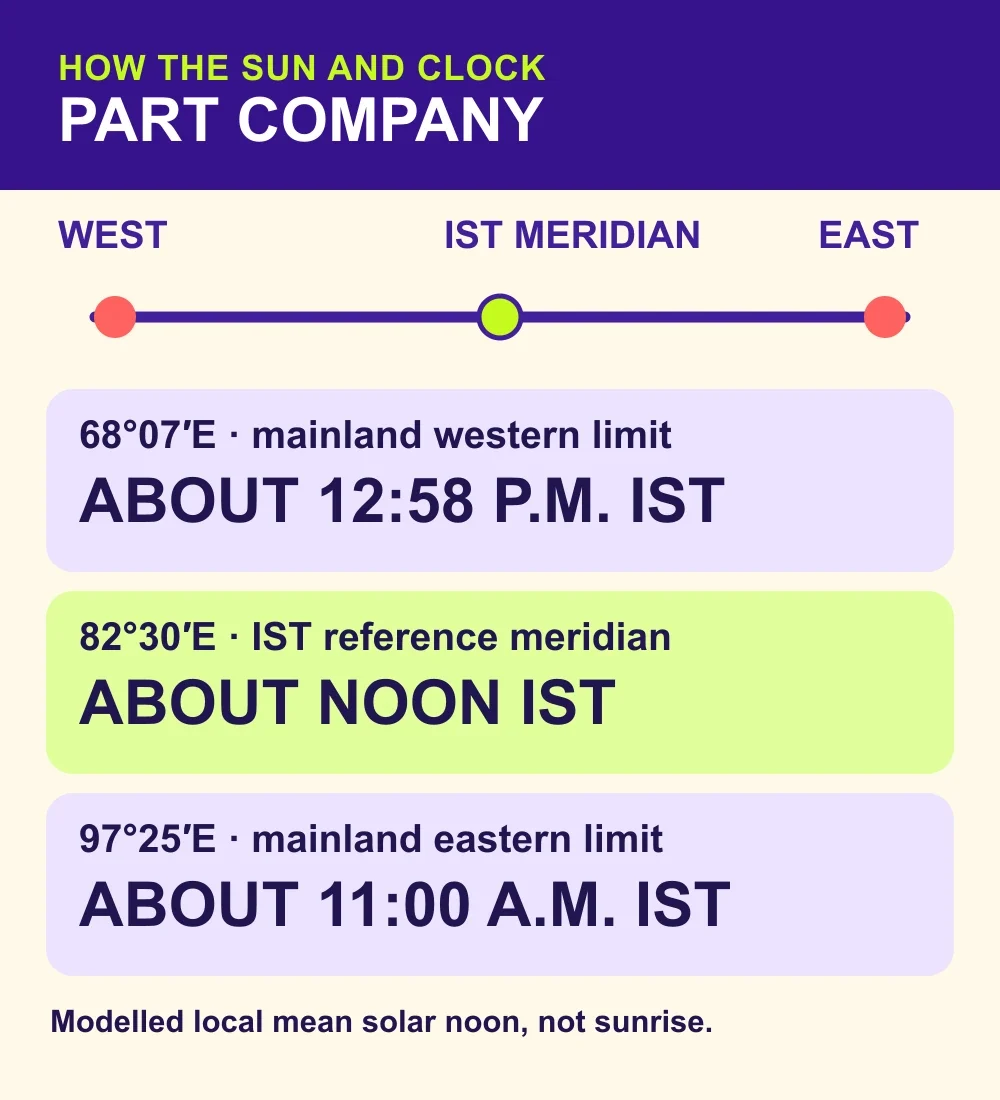
Modelled local mean solar noon at three mainland longitudes, shown on the IST clock: about 12:58 p.m. at the western limit, noon at the standard meridian and 11:00 a.m. at the eastern limit. These are longitude limits, not named towns or measured sunrise times; the actual moment of solar noon varies with the date. Sources: Central Water Commission (longitude limits), IMD (four-minute rule) and NPL (IST reference). Diagram: BharatQuests.
What does one clock mean for daily schedules?
Work and school hours are usually set by the official clock. In the east, daylight can begin and end earlier by that clock than it does farther west. A 2018 answer in the Lok Sabha acknowledged requests for a separate time zone from parts of the Northeast because sunrise and sunset there occur much earlier than official working hours. The answer reported a committee’s advice against two time zones for “strategic reasons”; it did not spell out those reasons.
A different official time zone would change the clock labels applied to the day in the affected area. A school or workplace could instead start earlier by the IST clock. Either choice changes how a schedule lines up with daylight; neither changes when the Sun rises. A second zone would also add a time boundary for people coordinating work, travel and family routines across it. India’s shared clock keeps those schedules on one reference, even when 8 a.m. falls at different points in the daylight hours.