How rising oil prices and a weaker rupee affect your budget
Why India’s import bill, petrol prices and household costs don’t rise together.
The Indian rupee closed at ₹95.44 to the US dollar on 10 September 2026, down 0.3% for the day. It was the currency’s third consecutive decline and its steepest daily fall since mid-July, according to Reuters. Rising oil prices and companies’ demand for dollars were among the pressures on the rupee.
The oil story began with a threat to supplies. Attacks on tankers during the US–Iran war had intensified, while traffic through the Strait of Hormuz, a route for oil shipments from the Gulf, remained restricted. Traders feared that less oil would reach buyers. Later on 10 September, Brent crude futures settled at $107.63 a barrel, up 6.34% that day, Reuters reported. Brent is a widely used reference price for crude oil, the unrefined oil processed into fuels such as petrol and diesel.
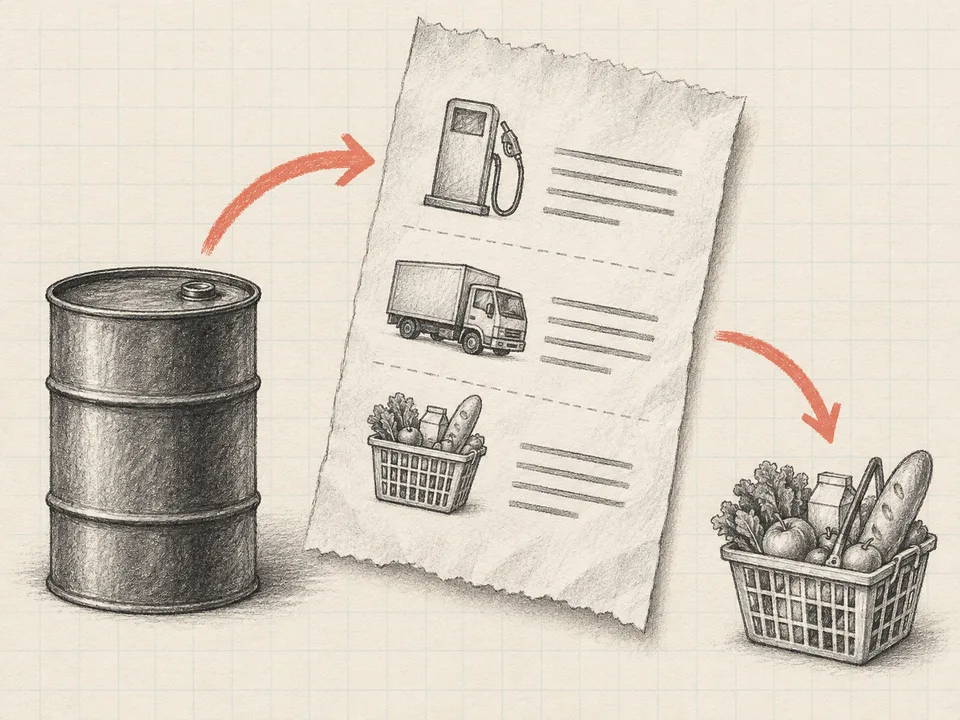
For India, rising crude prices and a weaker rupee can increase the cost of the same imported barrel in two ways. But a higher import bill does not immediately become a higher household bill. To understand what reaches your budget, we need to follow the oil through refineries, petrol pumps and the businesses that use the fuel.
Why rising crude oil prices matter so much to India
India produces some crude oil of its own, but imports supply most of its needs. A July 2025 RBI Bulletin study puts crude oil import dependence at 88.2% in 2024–25, up from 77.6% in 2013–14. In round numbers, about 88 out of every 100 units of crude consumed came from abroad.
Financial years; two observations, not an annual trend. Source: RBI Bulletin, 23 July 2025, section III.2.
That imported crude goes to refineries, which turn it into usable fuels. A refinery processes oil; it does not extract the raw material from the ground. So having refineries does not remove the need to buy crude abroad. When global prices rise, the imported part of India’s supply becomes more expensive.
How oil prices and the rupee affect the import bill
Oil bought in dollars has to be paid for with dollars. An Indian buyer therefore faces two prices: the dollar cost of the oil and the number of rupees needed to buy each dollar. If the rupee weakens, the buyer needs more rupees even when the oil’s dollar price stays the same.
Suppose a barrel costs $100 and a dollar costs ₹90. The example below shows how a rise in each changes the rupee bill.
- Starting point
$100 × ₹90 ₹9,000
- Oil rises; the exchange rate stays
$110 × ₹90 ₹9,900
- Oil rises and the rupee weakens
$110 × ₹95 ₹10,450
Dollars per barrel × rupees per dollar. The final raw-material cost is 16.1% higher than the starting point.
The oil-price increase adds ₹900 to the barrel’s cost. The weaker rupee then adds another ₹550. Together, they raise the raw-material bill by 16.1%, before shipping and other expenses. The next question is how much of that increase reaches the petrol pump.
There is also a feedback effect: a bigger dollar oil bill increases importers’ need for dollars, which can put further pressure on the rupee. Other flows matter too, including export earnings and overseas investment. This is why oil was one of several pressures identified in the September currency report.
What goes into petrol prices in India?
By the time petrol reaches a filling station, its price reflects more than the crude used to make it. Refining, transport, distribution and taxes all sit between the imported barrel and the litre you buy.
IndianOil’s price sheet shows how the final bill adds up. In this sheet, the dealer is the petrol-pump operator. The dealer’s commission is the amount allowed for selling the fuel and covering operating costs, not pure profit. VAT, or value-added tax, is the state tax shown on the sale.
The following snapshot is for Delhi, effective 1 August 2026. It illustrates the price structure before the September news; it is not today’s quote or a national average.
- Charged to dealers, excluding VAT
- ₹81.12
- Dealer commission (average)
- ₹4.41
- VAT, including VAT on commission
- ₹16.59
Rupees per litre. The dealer charge is not a crude-oil-only cost. Source: IndianOil, Delhi petrol price build-up, 1 August 2026 (PDF).
The dealer charge forms the largest part of this bill, but IndianOil does not break it down further in the sheet. It includes more than crude oil, so it cannot be used to isolate either the crude cost or the total tax share.
Who can change these amounts? Oil marketing companies set retail fuel prices; the central government sets central fuel duties, and states set VAT or sales taxes. Petrol pricing was deregulated in 2010 and diesel pricing in 2014, as the RBI study explains: companies were given responsibility for setting prices instead of the government fixing them directly.
That does not mean every change in crude prices produces an immediate change at the pump. A company can keep its selling price steady while its supply costs rise. It then earns less on each litre, or sells below its cost of supply. A decision earlier in 2026 shows how the government can also absorb part of the increase.
A ₹10 tax cut that did not lower pump prices
On 27 March 2026, during an earlier rise in oil costs, the petroleum ministry announced a ₹10-per-litre excise-duty reduction on petrol and diesel. Excise duty is a central government tax on the fuel. The announcement expressly said pump prices would stay unchanged.
The ministry said crude had risen from roughly $70 to $122 a barrel over the preceding month, and public-sector oil marketing companies were selling fuel for less than their cost of supply. Reducing the duty lowered that cost, giving companies relief without changing what customers paid.
In that March decision, the government accepted less tax revenue per litre and the companies absorbed less of the cost. The customer’s bill stayed the same. A May 2026 NIPFP review also described how pricing decisions and lower taxes had limited the retail effect of the oil surge. That episode shows how the government and companies can share the cost of keeping pump prices steady.
How fuel costs reach groceries and inflation

Even if you do not drive, diesel prices can matter to your budget. Consider a transporter delivering vegetables to a wholesale market. If fuel becomes more expensive, the cost of the trip rises. Whether the delivery charge changes immediately depends on the contract, competition and how much extra cost the transporter can afford to absorb.
The vegetable seller then faces a separate decision. A higher delivery charge might be passed on, partly absorbed, or offset by a fall in the wholesale price of the vegetables. Freight is only one part of the selling price; the harvest, spoilage, labour and demand matter too. Tomatoes have enough reasons to become expensive without giving oil all the credit.
This is also why a 10% rise in crude does not imply 10% inflation. The consumer price index tracks prices across a basket of household purchases, including food, housing and transport. Fuel affects only part of that basket, directly or through the cost of making and moving goods. The RBI study distinguishes the direct effect of changes in retail fuel prices from indirect effects through transport and production costs. The size and timing of the household effect depend on what actually changes along that chain.
What to watch after this week’s oil-and-rupee news
The 10 September report tells us that international oil prices and the rupee were moving in a direction that can make imports more expensive. The next questions are whether the increase persists, whether oil companies change petrol and diesel prices, and whether the government changes fuel duties. Local transport charges and shop prices provide a later, separate indication of what households are paying.
For now, the useful distinction is between a higher import cost and a higher household bill. The connection is real, but taxes and business decisions determine how much reaches the consumer. When a pump price stays steady, the question is not just whether oil has become more expensive. It is who is carrying the increase.