Where does an Indian municipality get its money, and who decides how it is spent?
Property tax is one source of city money. Applicable law controls what a municipality may collect, while grants and an elected council’s budget shape how it can spend the funds.

Who Decides?
On 15 October 2026, Payyannur Municipality's property-tax collection schedule was due to end. Its notice listed collection points across 46 wards from 14 September through 15 October, but did not say how much was collected. Once someone pays a city tax, who decides what that money pays for?
Who lets a municipality collect money?
A municipality cannot invent a tax. In India's states, Article 243X of the Constitution lets a state legislature authorize municipalities to levy and collect specified charges. The state can also assign some of its own tax receipts to municipalities and provide grants. Which charges a municipality can collect depends on the applicable law and the type of municipality it is.
Property tax is a familiar local charge. In Kerala, the Municipality Act lists local taxes, licence fees and rent from municipal property among receipts credited to a Municipal Fund. The municipality uses that fund to meet its duties. Paying property tax in one ward does not, by itself, reserve the payment for a named project there.
What else goes into the fund?
Kerala's Act also lists shares of state-collected taxes, state government grants for local plans or entrusted schemes, and donations. These come from outside the municipality's own taxes, fees and rent. The mix and amounts vary by municipality and year; a collection notice shows only one part of Payyannur's finances. Section 283 of the Act sets a further limit: specified licence fees must be accounted for separately and used for their purpose, while a scheme grant must be spent on the scheme for which it was released.
A State Finance Commission and the national Finance Commission have different jobs. Under Article 243Y, the state commission reviews municipalities' finances and recommends principles for sharing state revenue, assigning taxes and making state grants. The national commission addresses Union–state finances and local-body grants. The Union Department of Expenditure lists urban local-body grant guidelines for the 16th Finance Commission's 2026–27 to 2030–31 award period. That listing identifies the current grant cycle; it does not tell us how much Payyannur received or whether a grant can be used for any purpose.
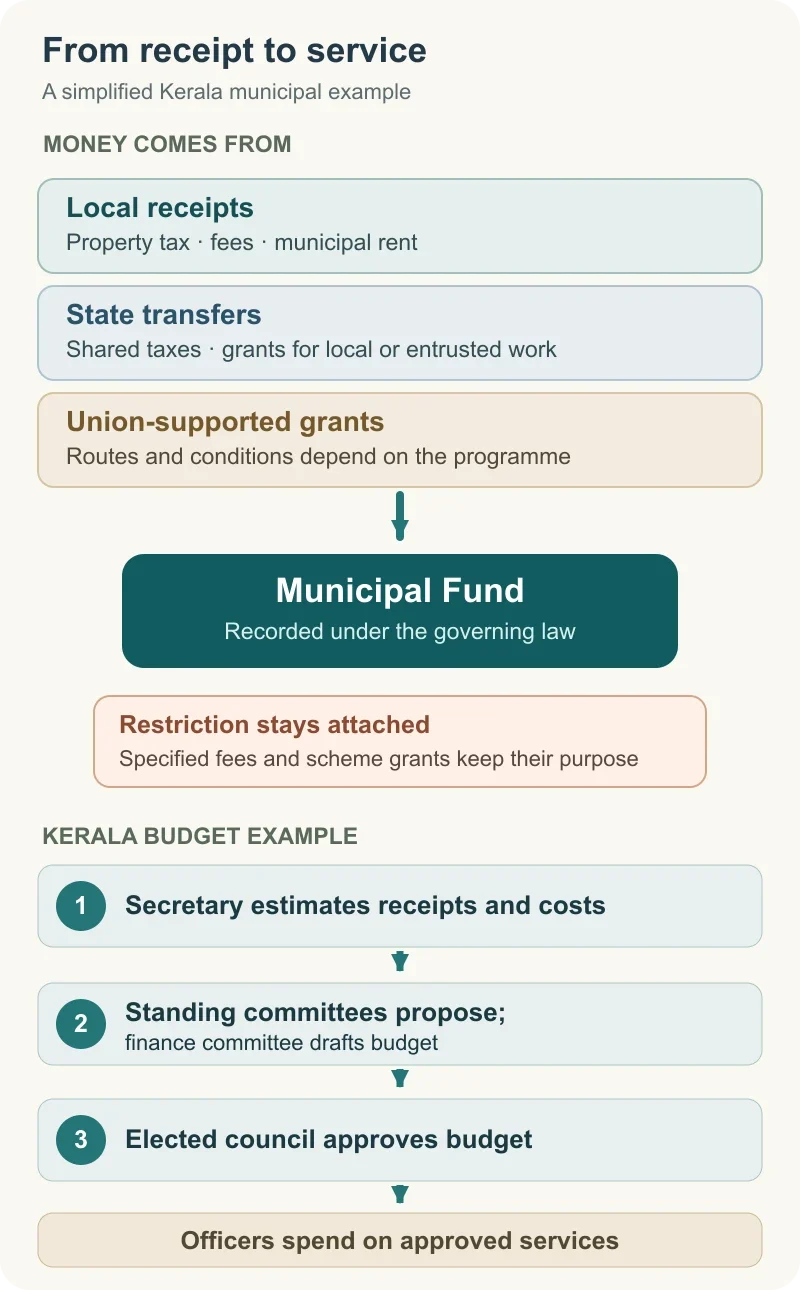
Diagram by BharatQuests. Revenue sources and approvals are a simplified Kerala example, with no actual Payyannur amounts. Routes for Union-supported grants depend on the programme; restricted fees and grants retain their legal purpose. Sources: Constitution, Articles 243X–Y, and Kerala Municipality Act, sections 283 and 285–289.
Who chooses the spending?
In Kerala, the Municipality Act's budget procedure begins with the municipal secretary's estimates of next year's receipts and costs. Standing committees for different services consider needs in their areas; the finance standing committee then prepares the budget estimate. The elected municipal council can change it and must pass the budget before the year begins. The secretary and other officers carry out spending under that approved budget and the law. A ward councillor can argue for a local need, but cannot individually assign each tax payment to a project.
Imagine residents asking for better street lighting. If their municipality provides that service, the council must weigh the request alongside other budget needs. Officers can then act within the approved provision. Even if the fund has money, a grant restricted to another scheme cannot simply be switched to lamps. This illustrates the decision path; it does not describe Payyannur's current lighting budget. Other agencies may also fund or run services inside a city, so a municipal budget does not cover all public spending there.
How can a resident check what happened?
A budget says what the municipality plans to receive and spend. To learn what happened later, look for its annual financial statement and audit records. Kerala's Act requires a council-approved statement for the previous year showing receipts, payments and balances, followed by audit. Compare that statement with the approved budget, while remembering that either may group many payments under one service. Reporting rules and the availability of records online vary elsewhere in India.
A tax notice alone cannot show which service a payment funds. To follow the decision, ask which law permits the charge, what budget the council approved and what the later financial statement says was actually spent. Those records can show who had authority and how money was used, even when they cannot trace one tax payment to one streetlight.