Who can add or remove your name from India's voter list?
An application or objection starts a check. The electoral registration officer decides whether an entry changes.

Who Decides?
On 10 October 2026, government broadcaster Akashvani reported that the Election Commission had limited how many Form 7 objections an individual elector could submit. The Indian Express also reported on the Commission's 9 October instruction. According to those reports, an individual elector can file up to 10 objections in a claims-and-objections period or five per month during continuous updating, whether online or offline. The reports say the Commission cited bulk objections on unsubstantiated grounds that burdened affected voters and field staff.
The limit governs how many objections an elector can file. It does not change the legal test for removing a name, and an objection alone cannot remove anyone from the voter list.
For Lok Sabha and state assembly elections, each constituency has an electoral roll: the official list of eligible voters registered there. An electoral registration officer, or ERO, is responsible for preparing and revising that roll. The Election Commission designates the ERO after consulting the state government; an assistant ERO may perform the role under the ERO's control. Representation of the People Act, 1950, sections 13B–13C.
Who can apply to be added?
A person missing from the roll can apply for inclusion with Form 6. The ERO checks whether the applicant is entitled to be registered. Broadly, that means Indian citizenship, being at least 18 by a qualifying date and ordinarily living in the constituency. Owning a house is not the test for ordinary residence; a temporary absence by itself need not end it. A person cannot be registered in two constituencies at once. 1950 Act, sections 16–20 and 23; ECI Form 6.
The form begins the process. The ERO can verify the information, decide on the application and, if the person was already enrolled elsewhere, arrange for the earlier entry to be struck after verification. A booth-level officer can help gather or check facts in the field. ECI, resident electors FAQ. The registration decision belongs to the ERO or an assistant ERO acting under the ERO's control, not the field worker. 1950 Act, sections 13B–13C and 23.
Can someone else ask for your name to be removed?
Form 7 allows an elector already on that constituency's roll to object to a proposed inclusion or seek deletion of an existing entry. The form lists grounds such as death, moving away, duplicate enrolment and ineligibility. It can also be used to request deletion of one's own entry. The person filing gives a reason; the ERO checks the facts before deciding. Registration of Electors Rules, 1960, rule 13; ECI Form 7.
Before correcting or deleting an entry because of a changed address or other ineligibility, the 1950 Act requires a reasonable opportunity for the affected person to be heard. In the draft-roll claims-and-objections process, the Rules also provide for notice and inquiry in contested matters. The procedure depends on the ground: the law does not require a personal hearing from someone who has died. 1950 Act, section 22; 1960 Rules, rules 16–20.
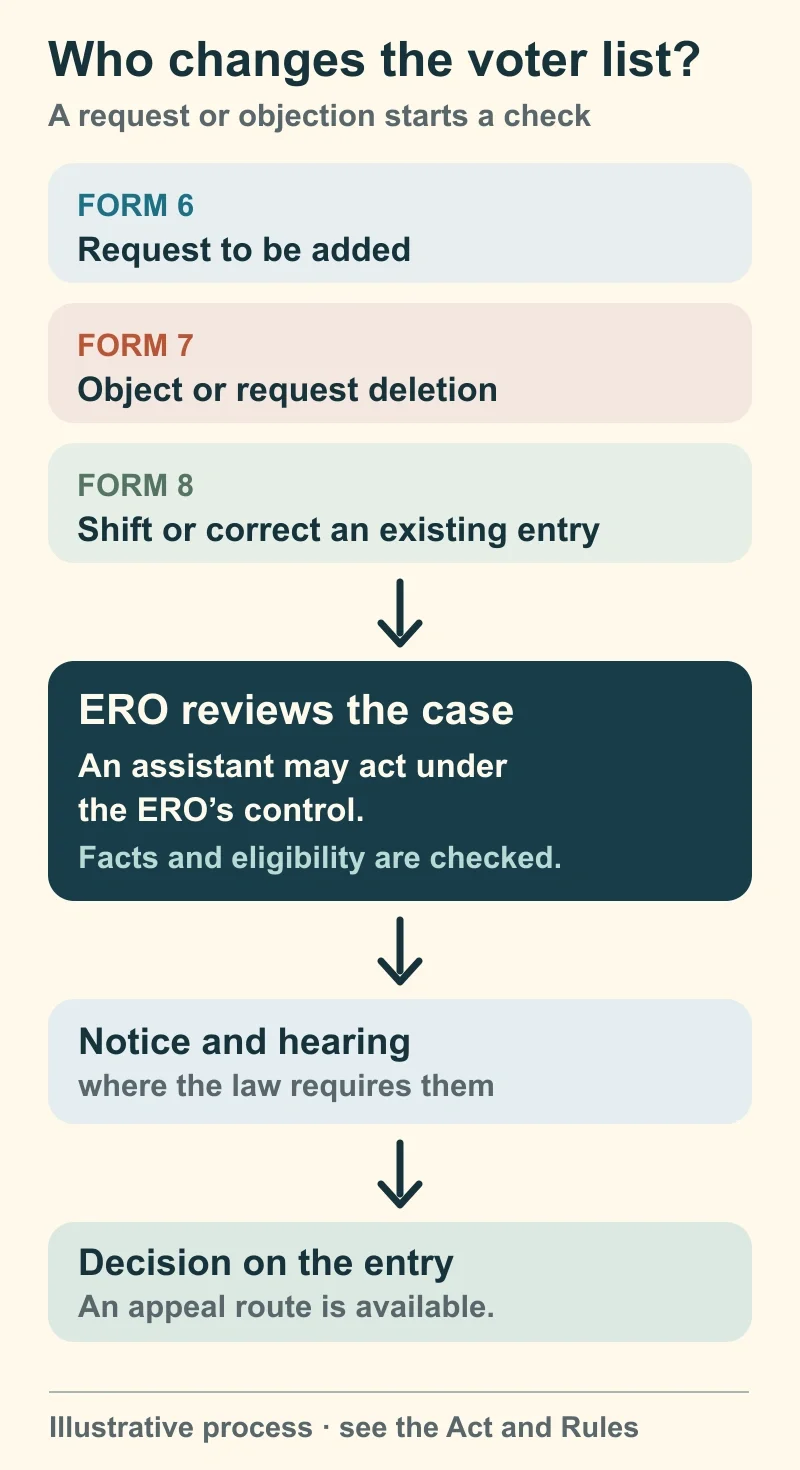
Illustrative route through the electoral-roll process; particular notices and revision schedules vary. Sources: 1950 Act, sections 13B–13C and 22–24 and 1960 Rules, rules 13 and 16–20. Diagram: BharatQuests.
What if you move or find a mistake?
An elector who changes residence or needs a correction uses Form 8 to request the relevant shift or change. That differs from Form 6 for a first application and Form 7 for an objection or deletion request. The ERO checks and updates the relevant roll; the forms do not make changes on their own. ECI Form 8; 1960 Rules, rule 13.
An ERO order to correct, delete or include an entry under sections 22 or 23 can be appealed through the route set out in section 24. The first appeal goes to a designated district-level authority, and a further appeal goes to the state's Chief Electoral Officer. If you think an ERO order is wrong, check the order and the current election timetable before appealing. 1950 Act, section 24; 1960 Rules, rule 27.
Where does the Election Commission fit?
The Election Commission supervises these rolls. The state Chief Electoral Officer supervises preparation, revision and correction under the Commission's direction; a District Election Officer coordinates work in the district. The state supplies the designated officials, while the ERO makes the constituency-level decision. An MP, MLA, councillor, party worker or person filing Form 7 cannot by themselves take a name off this roll. 1950 Act, sections 13A–13C and 22–23.
To check your registration, start with the Election Commission's voter services portal or your state's Chief Electoral Officer. If your entry is missing or challenged, identify the application or order and your constituency's ERO. The applicable revision notice gives the current timetable.