Who checks whether a Kolkata festival pandal is safe?
Fire-service permission, public-place approval and crowd planning address different risks. Learn who does what in Kolkata—and what each check cannot establish.

Series: Who Decides?
After the crowd crush at Kolkata’s Chorbagan Durga Puja pandal on 17 October, The Indian Express reported on 18 October that a state committee had been ordered to assess the remaining pandals and submit a report. (The Indian Express, 18 October 2026)
On 19 October, News On AIR separately reported that West Bengal’s chief secretary had asked the Calcutta High Court’s chief justice to recommend a sitting judge to lead an inquiry committee into the incident. The report described a request, not an appointment or a finding about what happened. The two reports describe separate processes: the first concerns the remaining pandals; the second is a reported request for a judge-led inquiry. As of the sources checked on 20 October, no signed judge-led inquiry order or final report had been located. (News On AIR, 19 October 2026)
AI-generated illustration by BharatQuests of a generic festival pavilion being prepared. It does not depict Chorbagan or the 2026 incident.
The request makes one practical question especially important: who checks whether a festival pandal is safe? In Kolkata, there is no single all-purpose “safe” certificate. Organisers prepare and run the site; West Bengal Fire and Emergency Services has a role for temporary structures covered by the law; the Kolkata Municipal Corporation can permit temporary structures on public places, with Kolkata Police concurrence; and crowd management continues while the event is open. These checks address different parts of the risk.
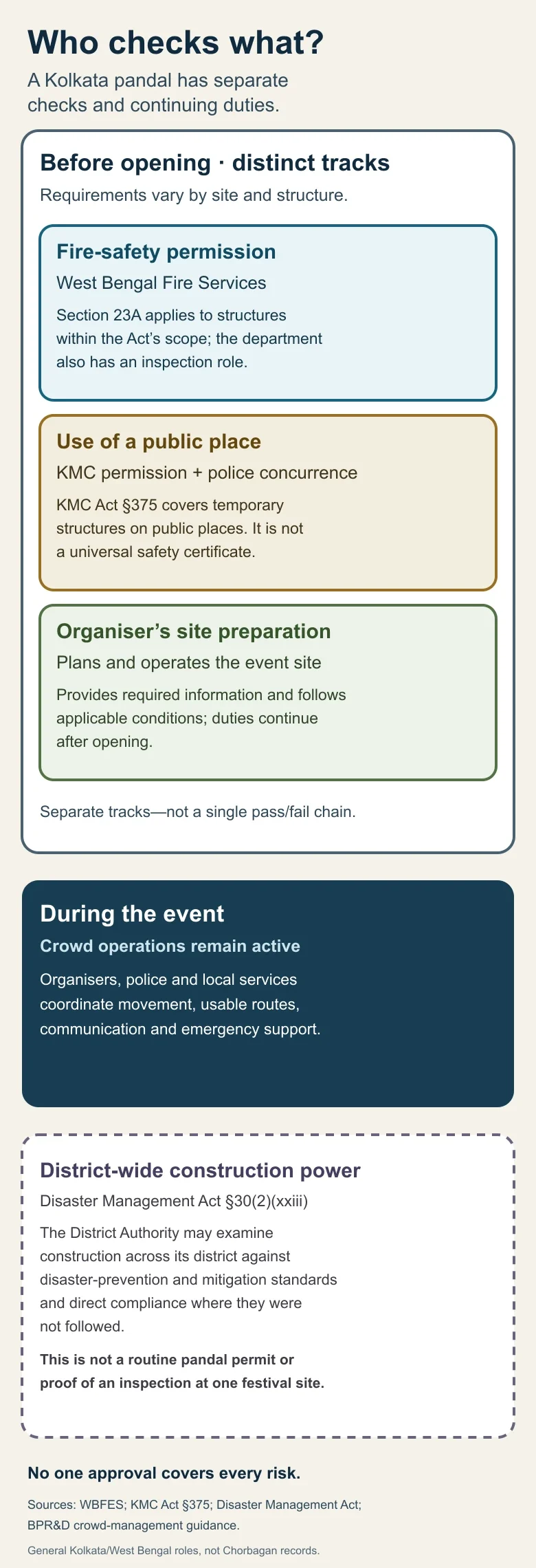
Illustrative diagram of Kolkata’s general safety roles; it does not show records of the Chorbagan event. Diagram: BharatQuests, based on the laws and guidance cited in this article.
Questions about what happened at Chorbagan, which approvals were sought or issued, and what each authority did are specific to the event. The sources reviewed for this explainer do not establish those facts. A general description of the rules cannot answer them.
The organiser prepares the site
A pandal organiser chooses a site, describes the proposed structure and makes arrangements to build and operate it. West Bengal Fire and Emergency Services says permission under section 23A of the West Bengal Fire Services Act applies to temporary structures that meet the Act’s definition. Its public application form requests details such as the site, area, purpose and operating period, along with a measured plan and information about the decorator and electrician. The exact requirement depends on the structure and applicable rules; these general materials do not show what any one organiser filed. (WBFES FAQ; application form)
The department also lists inspection of pandals and other temporary structures among its statutory functions. That does not mean every pandal receives an identical inspection at the same time, or that a fire-safety permission checks every aspect of crowd movement. To understand a particular event, one would need its application, permission and conditions, plus records showing what was inspected. (WBFES Duties and Functions)
A public-place permission is a separate track
The Kolkata Municipal Corporation Act addresses temporary structures on public places separately. Under section 375, the Municipal Commissioner may give written permission for a temporary booth, pandal or similar structure on a public place for a ceremony or festival, subject to conditions and a stated period. The Act requires the concurrence of the Commissioner of Police, Kolkata, before this permission is given. (Kolkata Municipal Corporation Act 1980, section 375)
This is permission to place a temporary structure on a public place. It is not a blanket certificate for every safety issue. Nor should the section be assumed to apply to a pandal on private land. Fire-service rules may still apply to a private-site structure if it falls within their scope. The site and structure determine which tracks are relevant.
Crowd management continues during the event
Even where the required permissions are in place, the event still has to be managed as conditions change. Entry and exit routes, queues, barriers, staff communication, emergency access and medical arrangements are operational questions. The Bureau of Police Research and Development’s crowd-management guidance and the National Disaster Management Authority’s festival-safety guidance discuss planning for these kinds of risks. They offer planning guidance; they are not proof of what was planned or done at Chorbagan. (BPR&D, Comprehensive Guidelines on Crowd Control and Mass Gathering Management; NDMA festival-safety guidance, summarized by PIB)
The Disaster Management Act gives a District Authority power to examine construction across its district against disaster-prevention and mitigation standards, and to direct compliance when those standards have not been followed. This power appears in section 30(2)(xxiii), alongside the Authority’s wider planning and response functions. It is distinct from a pandal permit or routine inspection of each festival site, and it does not establish that the Authority inspected Chorbagan. (Disaster Management Act 2005, section 30(2)(xxiii))
So the roles are related but not interchangeable: organisers prepare and operate the site; Fire Services handles the fire-safety process for structures covered by the law and has an inspection function; KMC may authorize temporary use of a public place with police concurrence; and crowd-management and emergency coordination continue during the event. Which approvals apply varies with the venue, structure and event.
What can visitors reasonably notice?
Visitors cannot check a site plan or determine whether a structure meets technical standards from the queue. They can notice whether exit signs are visible, whether a route is being blocked, whether stewards are giving clear directions and whether the crowd is becoming tightly compressed. If movement stops or conditions change, do not push forward; follow directions from event staff and public authorities and move toward open space when it is safe to do so. This is general safety guidance, not a substitute for event planning or emergency instructions.
A plan shows what is intended; it does not by itself show how an event operated at a particular moment. That is why permissions, any required inspections, organiser responsibilities and crowd operations need to be understood as separate parts of a wider system. For Chorbagan, the specific approvals, actions and causes remain matters for event records and the investigation—not conclusions that can be drawn from the general rules.