Who decides if you can fly the national flag at a protest in India?
Neither the Flag Code nor the 1971 Act requires permission to carry the flag respectfully. The Supreme Court has held that flying it with respect and dignity is protected as free expression; police, magistrates and site managers decide the gathering.

Who Decides?
As of 5:15 pm IST on 16 October 2026, the Cockroach Janta Party (CJP) had called a "Lehra Do Tiranga" gathering at Central Park in Delhi's Connaught Place for 5 pm that day. This article does not describe what happened at the venue. According to a PTI report of 14 October, a Special Executive Magistrate sent CJP leaders Saurav Das and Ashutosh Ranka to five days' judicial custody; police said they had violated peace bonds and trespassed into Jantar Mantar, which police describe as denotified as a protest area. CJP founder Abhijeet Dipke has said the leaders were jailed for unfurling the Tricolour. PTI reports the group allegedly "erected a national flag there". The police statement it quotes cites peace bonds and trespass and does not mention the flag, and the reports show no court ruling on which of these was the ground for custody.
Around 5 pm, National Herald, citing police sources, and The Logical Indian, citing an ANI video in which a police official is heard saying "We are placing you under preventive detention", reported that Delhi Police had detained Dipke as he left for the venue. We have not seen a police statement on this.
Earlier, for the 16 October gathering, Delhi Police said that a prohibitory order under section 163 of the Bharatiya Nagarik Suraksha Sanhita (BNSS) was in force around Connaught Place, and the New Delhi Municipal Council (NDMC) said Central Park would be closed to the public on 16 and 17 October "for administrative reasons". Police said permission for the march had not been granted, but that they could allow a small group to carry the flag and sing the national anthem at another place. ANI reported that Dipke was told waving the flag is not against the law but an unpermitted gathering would breach the restrictions. The Supreme Court declined an urgent hearing on a plea against the park's closure and indicated it might be listed around 26 or 27 October. These are reported accounts, and none of the reports establishes whether any order was lawful.
The legal question underneath is older than this week: when someone carries the national flag to a protest, who decides what they may do?
One flag, four separate decisions
Neither the Flag Code nor the 1971 Act requires anyone to seek permission to carry or display the flag respectfully. Several institutions decide different things around it, and news coverage can blur them together.
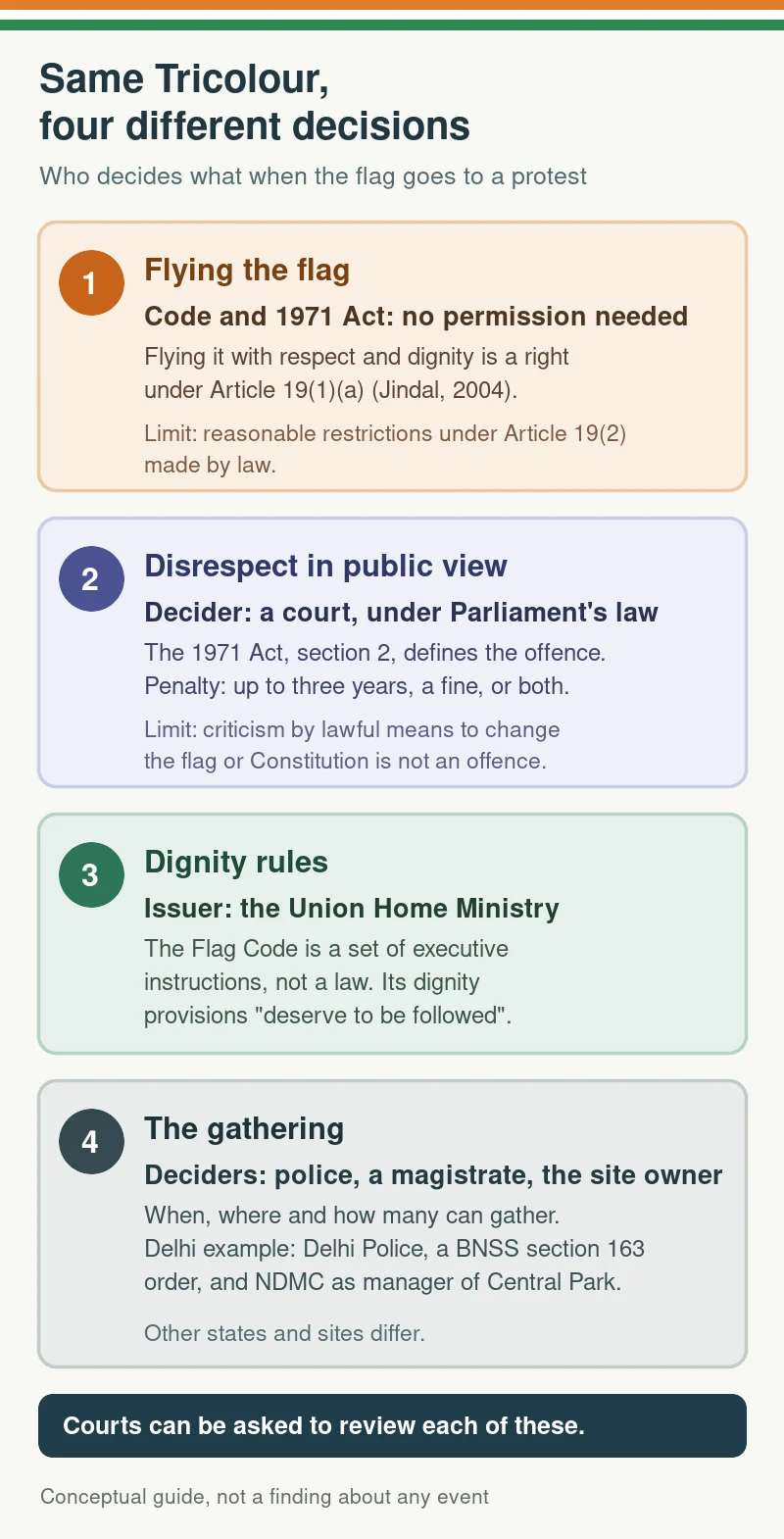
Four questions, each decided by a different body. The gathering example is specific to Delhi; other states and sites differ. Sources: Supreme Court, Union of India v Naveen Jindal (2004); Prevention of Insults to National Honour Act, 1971; MHA salient features of the Flag Code. Diagram: BharatQuests. Separately, the Emblems and Names (Prevention of Improper Use) Act, 1950, section 3, requires Central Government permission to use the flag for trade, business, a calling or profession; it does not concern display at a protest.
Is flying the flag a right?
In Union of India v Naveen Jindal (2004), the Supreme Court dealt with a company director who had been stopped from flying the flag at his factory under the Flag Code. The Court held that the "right to fly the National Flag freely with respect and dignity is a fundamental right of a citizen within the meaning of Article 19(1)(a)", the freedom of speech and expression in the Constitution. The judgment concerned a flag flown at a factory and does not address protests specifically. It added that the right is qualified, not absolute: it is subject to reasonable restrictions under Article 19(2), which only a law can impose. The Delhi High Court restated this in October 2025 in Reepak Kansal v Union of India, calling the right "neither unfettered nor untrammeled".
The Emblems and Names Act, section 3, adds a permission requirement only for use in trade, business, a calling or profession. The 1971 Act forbids treating the flag disrespectfully; whether a crowd may gather is a separate question, covered below.
What does Parliament make an offence?
Parliament has defined the offence in the Prevention of Insults to National Honour Act, 1971. Section 2 applies to someone who, in a public place or in public view, burns, mutilates, defaces, defiles, disfigures, destroys, tramples on or otherwise shows disrespect to or brings into contempt the flag. The punishment is up to three years in prison, a fine or both. The Act says that comments seeking to change the flag or the Constitution by lawful means are not an offence. Its explanations also list specific acts that count as disrespect; the Home Ministry's FAQ summarises several, such as lettering on the flag, using it as drapery or letting it touch the ground.
Whether a particular act meets that definition is ultimately decided by a court, not by the person who sees it or by whoever polices a gathering. The offence concerns what is done to the flag. The Act's list does not treat respectful carrying or waving as disrespect.
Is the Flag Code a law?
The Flag Code of India, 2002 is issued by the Union Home Ministry. The ministry's summary says a member of the public, a private organisation or an educational institution may display the flag on all days and occasions, consistent with its dignity and honour. The Code also covers details such as the 3:2 proportion, not flying a damaged flag and not placing another flag above it. It was amended in 2021 to allow machine-made and polyester flags, and in 2022 to allow flying the flag day and night in the open.
In Jindal, the Supreme Court said the Code is not a "law" under Article 13(3)(a) and so cannot itself restrict the right, though its provisions on respect and dignity "deserve to be followed". Breaking a Code instruction is therefore not by itself the offence; criminal liability sits in the 1971 Act. Police can still remind people of the Code's dignity rules, as ANI reported they did on 16 October.
Who decides whether a gathering can happen?
That is a different question from the flag, and it is the one at the centre of the 16 October dispute. Our earlier explainer, Who decides where a protest march can go?, sets out the Delhi Police and BNSS powers. In short, a gathering's time, place and size can be regulated by the police, or by a magistrate's written order under BNSS section 163, subject to Article 19(1)(b) and court review. Delhi Police's position, as reported, is that waving the flag is lawful but does not exempt a gathering from such orders.
A third decision-maker is whoever controls the site. Central Park is managed by the NDMC, which described its closure as administrative. Under the NDMC Act, section 4, the Central Government appoints the Chairperson after consulting Delhi's Chief Minister, nominates five officers and two other members (the latter in consultation with the Chief Minister), and three members are Delhi MLAs. This describes who sits on the council, not who ordered the closure. The reports do not say what statutory power NDMC used, and they do not establish whether the closure was proportionate. The Supreme Court has not ruled on that. As ETV Bharat reported, the bench said it hoped better sense would prevail and that it could act if measures were found disproportionate.
Courts also decide what happens to individuals. A magistrate orders remand, and whether anyone committed an offence is for a trial court to decide. The allegations about Das and Ranka are police allegations at this stage.
Does the answer change outside Delhi?
The flag rules do not change: the 1971 Act extends across India, and Jindal binds every court. What changes is the gathering. In most states, police and public order are state subjects under the Seventh Schedule, so a state police force, a district magistrate or a police commissioner applies state law and local procedure. Delhi is unusual because Article 239AA keeps police and public order outside its Assembly's ordinary powers. The site's manager also varies: a municipal corporation, a cantonment, a state department, Railways or a university.
For any dispute involving a flag at a protest, it helps to ask which of the four decisions is in question: the right to display it, an alleged offence against it, a Code instruction, or the permission and place for a crowd. The answer shows who decided, and where a challenge could be taken.
Cover photo: Indian flag in Sanjeeviah park by Mhdmzml, CC BY-SA 4.0, cropped.
