Who creates a new district in India?
State governments create or change administrative districts under state law. A Gazette notice makes the boundary official; staffing, offices and funding take further decisions.

Who Decides?
Can an MLA or MP make a town the headquarters of a new district? For an ordinary administrative district within a state, the state government makes the legal decision under that state's law. A representative can argue for the change, and residents can press their case, but an announcement does not redraw a district boundary. The change must follow the applicable law and appear in the state's official notification.
What is the state changing?
A district is an administrative area within a state. Its boundary helps determine which district administration handles a place; its headquarters is where the main district offices are based. It is neither another state nor the same thing as an MP's parliamentary constituency or a municipality. In many rural areas, an elected district-level panchayat, often called a zilla parishad, operates under a separate legal framework from the district collector's administration. Part IX of the Constitution sets out this panchayat tier, with exceptions. Parliamentary constituencies, municipalities and panchayat jurisdictions follow their own applicable legal rules and orders.
The Constitution's Article 3 gives Parliament a law-making route for forming or altering states. Creating or altering a revenue district inside an unchanged state ordinarily uses state law. The question here concerns districts within states; Union territories can have different arrangements.
How does a proposal become a district?
In Maharashtra's Land Revenue Code, section 4 lets the state government specify and alter revenue areas, including districts, through a notification in the Official Gazette. Section 4 also requires previous publication: the proposal is published before the final action. The Gazette carries the state's formal notice of the legal change; a speech or news report does not serve that purpose.
Andhra Pradesh shows how public views can enter the process. The East Godavari district administration reproduces the state's 2022 formation notice: proposals were published, objections and suggestions from affected people were considered, and the reorganised East Godavari district took effect on 4 April 2022, with Rajamahendravaram as headquarters. A later 2025 notification changed which mandals it included. The 2022 notice records that reorganisation; it is not a current boundary map.
In both examples, the state follows a legal process and publishes a final notice specifying the change and when it takes effect. The notice and consultation requirements depend on the state's law; there is no single objection deadline or district-creation form for all of India.
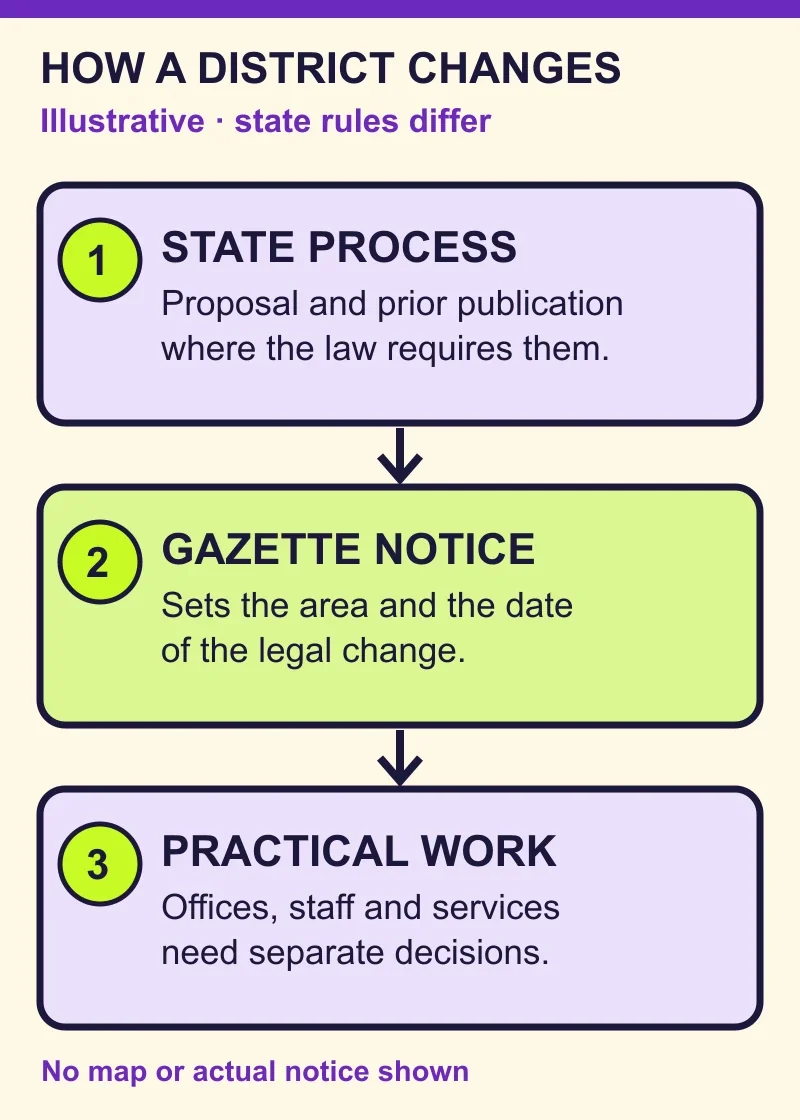
Illustrative process, not a nationwide legal checklist. Maharashtra's Land Revenue Code, section 4 requires previous publication; the East Godavari administration's 2022 notice records published proposals and consideration of objections and suggestions in Andhra Pradesh. Diagram: BharatQuests.
Does a new boundary bring new services and money?
The notification identifies the administrative change. Making it work also takes people, premises and records. In a 2022 Andhra Pradesh account of its district reorganisation, officials were asked to prepare the division of employees, infrastructure and buildings so district collectors and police superintendents could begin work. Those were practical tasks alongside the boundary decision.
Paying for the changes is a separate step. Articles 202–204 of the Constitution set out state budget estimates, Assembly grants and appropriation for spending from the state's Consolidated Fund. A district notification does not itself earmark a specific budget for new offices. Departments may rearrange existing approved resources or need further decisions for additional staff, buildings and services. A new district boundary also does not guarantee a new hospital, court, municipality or parliamentary seat.
For a resident, the useful documents are the final state Gazette notification, its schedule of included areas and effective date, and any departmental orders about where a particular service will operate. They answer different questions: which district a place belongs to, and which office will serve it. The legal boundary is one decision; putting it into practice takes further work.