Who decides when a coastal area is evacuated before a cyclone?
A weather warning describes danger; state and district authorities decide protective steps and organise local action under their plans. Here is how the roles fit together.

Who Decides?
On 12 October 2026, the India Meteorological Department (IMD) launched a public map bringing cyclone forecasts and marine-weather hazards together. A forecast can show danger approaching a coast. Who decides whether people in an exposed area should move? Ministry of Earth Sciences release.
Who gives the warning, and who acts on it?
IMD forecasts and communicates the weather hazard: a cyclone's likely path, wind, rain and coastal effects. It does not decide which settlements should evacuate or run their shelters. Disaster authorities combine the forecast with local information: which homes are exposed, where safe buildings are, and how people can reach them. The national Disaster Management Act, 2005, read with its 2025 amendment, assigns parts of this work to state, district and local authorities.
At state level, the State Executive Committee coordinates disaster response. Section 24 of the Act lets it direct state departments, district authorities and other relevant authorities to take steps for rescue, evacuation or immediate relief when a disaster threatens. The 2025 amendment also includes any constituted urban disaster authority among those it can direct. A weather bulletin alone is not an evacuation direction. Act, sections 20 and 24; 2025 amendment, section 15.
The District Disaster Management Authority plans and coordinates the district response. It is ordinarily chaired by the Collector, District Magistrate or Deputy Commissioner. Under the Act's emergency provisions, it can direct district departments and local bodies, organise shelters and services, and restrict traffic or movement in a vulnerable area. State departments and local authorities provide people, buildings and services on the ground. The hazard and the applicable state and district plans shape which areas, routes and shelters are involved. Act, sections 25, 30, 33–34 and 38–41, as amended in 2025.
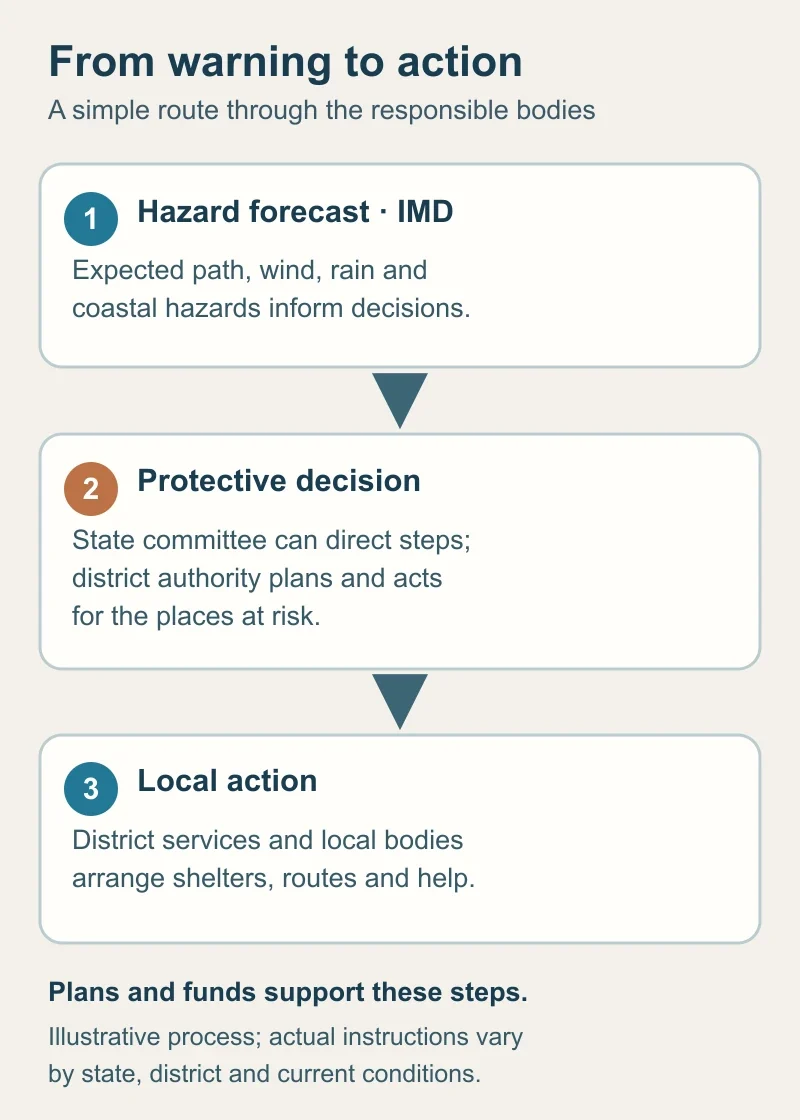
Illustrative process by BharatQuests, based on the Disaster Management Act and its 2025 amendment. Exact arrangements depend on the place and the order issued.
What might that look like in one district?
Suppose an official forecast warns that dangerous winds and coastal flooding could affect several low-lying settlements. The state may direct protective measures; district officials can identify exposed homes, prepare suitable shelters and arrange access and transport with local bodies. This is an illustrative chain, not a report of an October 2026 evacuation. The warning describes the threat; the local instruction specifies the places and actions it covers.
In May 2020, ahead of Cyclone Amphan, Odisha's Special Relief Commissioner told district administrations to prepare shelters and instructed the collectors of four named districts to evacuate people in specified vulnerable housing and low-lying areas by 19 May. The report shows a state direction sent to district officials for action during that storm. Odisha preparedness report, 18 May 2020.
Who pays, and why can the process vary?
State budgets provide for planned disaster measures; statutory disaster funds can support eligible response under their guidelines. The 2025 amendment updates how national and state funds are applied. Funding supports the response; authorities still have to decide which areas need evacuation. Act, sections 23, 40 and 46–49; 2025 amendment, sections 27–29; Ministry of Home Affairs response-fund explainer.
The process can also vary by city. A 2025 provision allows a state to constitute a separate urban disaster authority for eligible cities, with its other powers set by that state; it does not mean every city already has one. For a resident, the practical distinction is between a weather warning about the hazard and the current state or district instruction about whether, when and where to move. 2025 amendment, section 23 inserting section 41A; NDMA's public advice.