Who decides where a protest march can go in India?
Organisers choose where they want to march. Delhi's police law allows route directions; separate powers govern bans and urgent orders.

Who Decides?
On 12 October 2026, The Indian Express reported a proposed march from the Connaught Place area towards the Supreme Court in Delhi. PTI's on-scene report described barricades on Bhagwan Das Road. When organisers want to take a protest along a particular street, who decides whether it can go that way? The reports do not establish which legal order applied to that day's barriers.
People choose the march they want to hold. The police and other authorities named in law may regulate its route, time or assembly area. A direction changing the route, a prohibition on an assembly and an urgent public-order order use different powers.
What does the right to assemble protect?
Article 19(1)(b) of the Constitution protects citizens' right to assemble peaceably and without arms. Article 19(3) permits reasonable restrictions imposed by law in the interests of India's sovereignty and integrity or public order. A peaceful march therefore has constitutional protection, but that protection does not reserve its organisers' first-choice street and hour regardless of other uses of the road. A restriction needs a legal basis and remains open to judicial scrutiny.
In a 2018 judgment about protests at Delhi's Jantar Mantar, the Supreme Court rejected a blanket end to demonstrations there and called for a system of limited, regulated use that considered protesters and nearby residents. That judgment did not decide whether any 2026 Delhi march or barricade was lawful.
In Delhi, who sets the street and time?
The Delhi Police Act, section 29, gives the Commissioner of Police, and an officer of at least Inspector rank subject to the Commissioner's orders, power to direct processions and assemblies on streets. The officer may specify routes and times, including where a procession may or may not pass, and act to prevent obstructions. These directions can be oral or written and must stay within the Act's regulations and other applicable law. In Delhi, that is who may change a march route under section 29; a councillor or MP does not make that individual decision.
A city body may maintain the road, and elected representatives may debate the wider rules. Neither role gives them the power to issue a Delhi Police Act route direction.
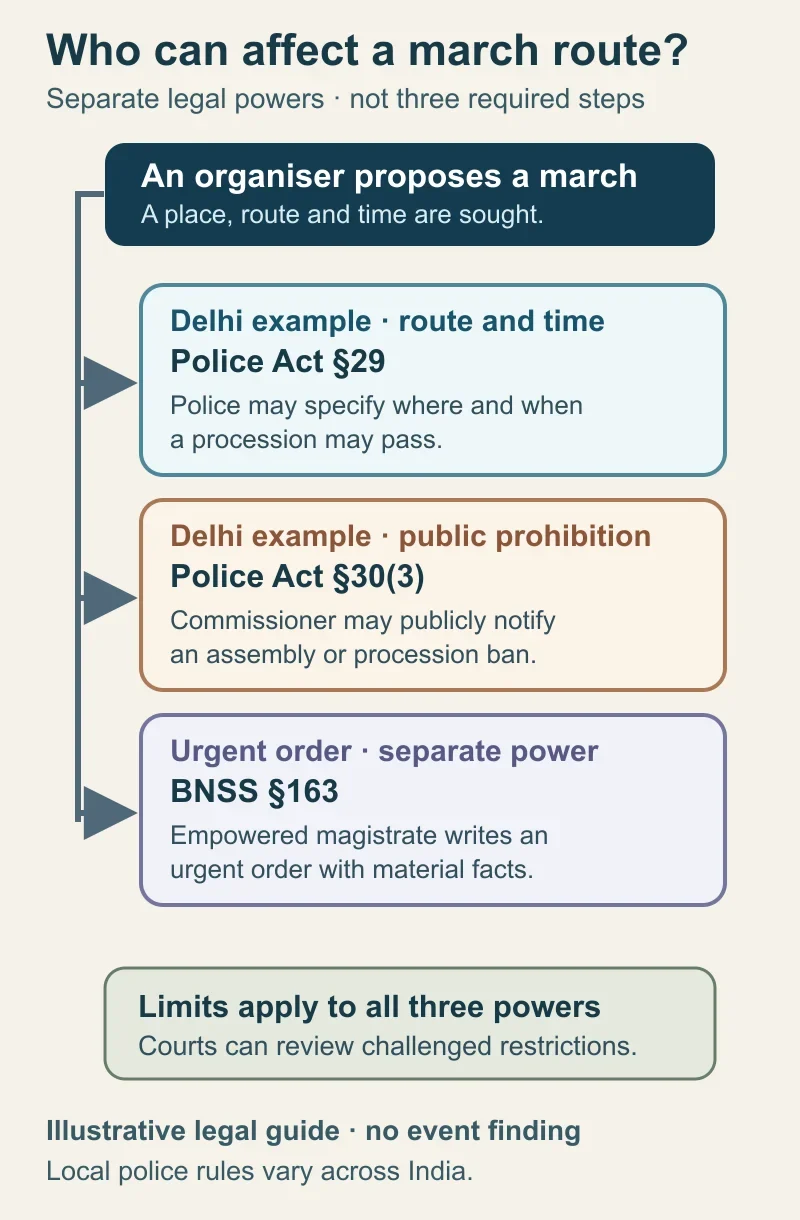
Three different legal powers that may affect a march, not a checklist for organisers or a finding about the 12 October event. The two police-law examples are specific to Delhi; urgent orders under BNSS section 163 have their own statutory conditions. Delhi Police Act, sections 29–30; BNSS, section 163. Diagram: BharatQuests.
When is a restriction more than a route change?
Section 30(3) of the Delhi Police Act lets the Commissioner publicly notify a prohibition on an assembly or procession for a period considered necessary to preserve public order. That is a distinct power from section 29's directions about where and when people may pass. Its notification must be read to know the area and time it covers. The Act normally limits a section 30(3) notification to 15 days; a longer period requires the Administrator's separate gazetted order under section 30(4). Delhi Police Act, section 30.
Another distinct tool is an urgent written order under section 163 of the Bharatiya Nagarik Suraksha Sanhita. A specially empowered magistrate can use it where the statutory urgency and risk conditions are met, stating the material facts. It can apply to specified people or an area, and affected people may seek its alteration or rescission. A police route direction is not automatically such an order. To identify the power used, read the actual order and who issued it.
Does the answer change outside Delhi?
In most states, police and public order are state subjects under the Constitution's Seventh Schedule. State laws and local rules can therefore set different authorities and procedures. Delhi is unusual: Article 239AA keeps public order and police outside the Delhi Legislative Assembly's ordinary legislative powers. Delhi Police's routine expenses appear under the Union Home Ministry's 2026–27 Police budget demand. The budget shows where that funding comes from; the Delhi Police Act establishes who may direct a route.
When a march route is contested, ask which current direction or order applies, who issued it, which roads and hours it covers, and under what law. Courts can examine whether a restriction respects the right to peaceful assembly. A photograph of a barrier tells you where access was limited at one moment; the order and its reasons tell you what decision is being defended.