What does India actually get from BRICS?
Follow the development-bank money, India’s diplomatic access and the limits behind the bloc’s giant numbers.
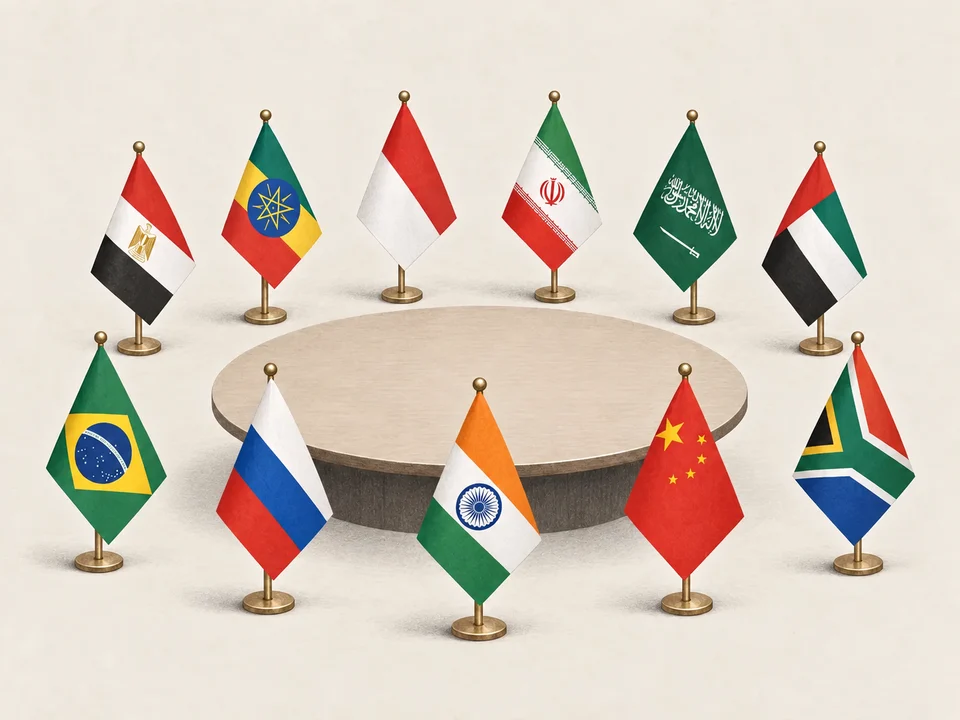
India hosted the 18th BRICS Summit in New Delhi on 12–13 September 2026. The headline figures are imposing: the 11 members account for about half the world's population, 40% of global GDP and 26% of global trade, according to the Indian government's summit backgrounder.
Those numbers show the group's economic reach. Its value to India depends on what the members can finance or negotiate together.
So what does India actually get? The clearest answer is another source of infrastructure finance, a seat in a large non-Western forum and regular diplomatic access across rival camps. Each works through a different institution or relationship.
What BRICS is—and is not
BRICS began as meetings among Brazil, Russia, India and China, with South Africa joining later. Expansion has taken it to 11 members: the original five plus Egypt, Ethiopia, Indonesia, Iran, Saudi Arabia and the United Arab Emirates.
BRICS describes itself as an informal political and diplomatic coordination forum. It has no constitutive treaty, permanent secretariat or budget of its own, and members take decisions by consensus, according to its official institutional guide.
That design matters. A BRICS statement cannot by itself lower a tariff, deploy forces or change the United Nations Security Council. But informality also lets India sit with China, Russia and Iran without signing up to a common foreign policy. To find the value, we have to look for specific machinery rather than a single grand BRICS policy.
The most concrete benefit is a bank
The New Development Bank, or NDB, is the strongest example. The original five BRICS countries created it in 2014 to finance infrastructure and sustainable-development projects. Under the founding agreement, each founder initially subscribed USD 10 billion of capital: USD 2 billion paid in over time and USD 8 billion callable if the bank needs it. Voting power is tied to shares, and the agreement gives India the same initial subscription as China.
Most of the subscription is a promise to supply capital if needed. NDB financing is generally a loan that the borrower must repay. India's subscription gives it a shareholder's voice in the lender, while Indian projects can apply for its financing.
By 30 June 2026, the NDB said it had approved 35 projects in India worth USD 10.5 billion, of which roughly USD 6 billion had been disbursed. India was the bank's second-largest recipient and accounted for 24% of its loan portfolio, according to remarks by the NDB's vice-president. “Approved” sets a financing ceiling; “disbursed” is the money actually released as work progresses. Neither word, by itself, means a project is complete or successful.
USD 9.534 billion across 32 approved projects at this cutoff. Categories and values are the lender’s classifications. Source: New Development Bank India factsheet (PDF).
The sector mix shows what this access looks like on the ground. At the end of 2025, more than half of the bank's approved India portfolio was classified as transport infrastructure. Water, sanitation, clean energy and projects spanning several sectors made up most of the rest. These are not uniquely BRICS priorities, but the bank adds another financing channel alongside India's budget and lenders such as the World Bank, Asian Development Bank and Asian Infrastructure Investment Bank.
A railway shows both the benefit and the limit
The Delhi–Ghaziabad–Meerut Namo Bharat corridor shows how this financing works in practice. The 82.15-kilometre rapid rail line became fully operational in February 2026. By 6 August, the National Capital Region Transport Corporation had recorded more than 3.8 crore cumulative trips and punctuality above 99%, the housing ministry told Parliament.
- Government and other sources
- $1.789bn
- Asian Development Bank
- $1.049bn
- Asian Infrastructure Investment Bank
- $0.5bn
- New Development Bank
- $0.418bn
- Japan Fund grant
- $3m
NDB’s USD 418 million limit is about 11.1% of the plan by BharatContext calculation. Source: New Development Bank project page.
The bank's current project page puts its financing limit at USD 418 million in a USD 3.759 billion plan—about 11.1% by calculation. The Asian Development Bank, Asian Infrastructure Investment Bank, a Japanese grant and government or other sources supplied the rest. The Republic of India is the borrower.
Here, several lenders share the financing alongside government and other sources. The NDB gives India another institution from which to assemble long-term capital, with a founding voice in how that lender operates.
The record is uneven. The NDB's independent evaluation office rated its India portfolio moderately successful overall in a 2024 review. It found strong alignment with India's priorities and assessed effectiveness and expected impact positively. But it also documented delays or very low disbursement in at least nine of the 26 projects it examined. Local-currency finance, private-sector lending and project supervision had not developed as quickly as intended. The evaluation is a useful correction to the idea that a new bank automatically means faster or easier infrastructure.
The second benefit is a microphone—and a listening post
India also uses BRICS to argue that global institutions give developing economies too little influence. At the IMF, for example, India currently has 2.63% of the votes, according to the fund's 10 September quota table, even though it is one of the world's largest economies. In May, External Affairs Minister S. Jaishankar used a BRICS meeting to call for reform of the UN Security Council, multilateral development banks and the rules-based trading system.
BRICS cannot make those reforms alone. Its value is that India can help shape a common demand and make it harder to dismiss as one country's complaint. Even here, the wording reveals the limit. A May 2026 chair's statement said China and Russia supported the aspirations of Brazil and India to play a “greater role” at the United Nations. That is diplomatic support, but it is not a promise of a permanent Security Council seat.
The forum is also a listening post. India belongs to the Quad with the United States, Japan and Australia; it works with Western economies in the G20; and it sits in BRICS with China, Russia and Iran. These memberships do different jobs. Remaining in BRICS lets New Delhi meet states that disagree sharply with one another while avoiding dependence on a single geopolitical camp.
Analysts at Carnegie describe this as part of India's multi-alignment strategy: stay in the forum, resist turning it into an explicitly anti-Western coalition and avoid leaving its direction entirely to China. The immediate value of that strategy is access. Prime Minister Narendra Modi's summit-side meeting with Russian President Vladimir Putin on 11 September covered trade, energy, defence and current conflicts. Those were bilateral talks enabled by the gathering, not BRICS policies.
Trade is large, but it is not a BRICS dividend
BRICS members are important commercial partners for India. The commerce ministry estimated India's merchandise exports to the group at USD 82 billion in 2025–26, while services exports were USD 31.3 billion in calendar 2024. The periods differ, so the two figures should not be added into one annual total.
More importantly, BRICS is not a free-trade area. A shipment from India to Brazil or China does not receive a BRICS-wide tariff preference simply because both countries attend the summit. Trade depends on bilateral demand, prices, shipping, national rules and separate agreements. The size of the flow shows why the relationships matter; it does not show that the forum created the trade.
India's 2026 chairship has produced some narrower proposals. BRICS trade ministers agreed in August to study an invoice-discounting mechanism for smaller exporters and adopted guiding principles for assessing credit for export-oriented MSMEs. They also prepared workplans on services and supply chains. These may become useful, but at the August meeting they remained proposals and workplans—not an operating source of cheaper credit.
Consensus protects India—and limits BRICS
The consensus rule is a double-edged feature. India cannot be formally committed to a BRICS decision it rejects. That gives it a measure of protection in a group where China has a much larger economy and where members disagree on wars, borders, sanctions and relations with the West.
The same rule also reduces what BRICS can deliver. Eleven governments with different interests can agree on broad language more easily than on who pays, who implements and when. Expansion increases the group's reach while making a coherent common programme harder.
So, is BRICS worth it for India?
The financing record and diplomatic access give India concrete reasons to stay involved. To judge the next initiative, look for its financing source, operating rules, deadline and institution responsible for delivery. Our account of the New Delhi summit's outcomes applies that test to the agreements and discussions of 12–13 September.