Who decides when Delhi's GRAP pollution curbs start, and what they ban?
CAQM writes the Graded Response Action Plan and its Sub-Committee triggers each stage. States, pollution boards and the Delhi government enforce it; the Supreme Court has pushed for stricter action.

On 28 September 2026, the Commission for Air Quality Management in NCR and Adjoining Areas (CAQM) approved a revised Graded Response Action Plan for Delhi-NCR ahead of winter. Media reports of the order count 48 actions across four stages. On 16 October, CAQM's enforcement task force reported 124 inspections and 55 violations, covering construction sites, industrial units and diesel generator sets, between 25 September and 9 October. As of 17 October 2026, we found no CAQM order invoking a stage in the past week. The question for winter is who decides when each stage starts, and who decides what it bans.
The short answer: CAQM's full Commission writes the schedule, a CAQM Sub-Committee on GRAP invokes and revokes the stages, state governments and pollution boards carry them out, the Supreme Court has pushed for stricter action, and the Centre decides what its own offices do.
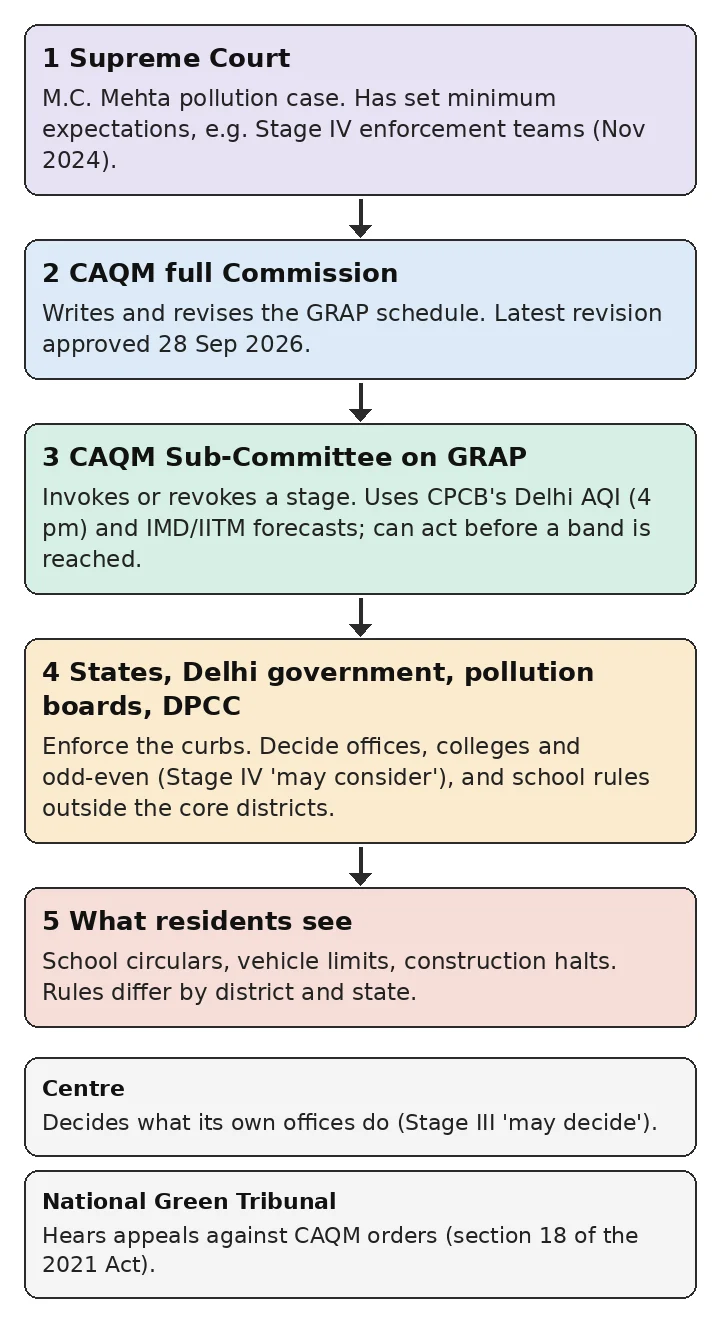
Who decides what in Delhi-NCR's GRAP. Sources: CAQM Act, 2021; PIB, 16 January 2026; Tribune on the Supreme Court's 18 November 2024 order. Diagram: BharatQuests.
Is GRAP an emergency law?
No. GRAP is a graded plan, not a statutory "emergency" that someone declares. It lists actions that become compulsory as Delhi's air worsens, and the actions are cumulative: a higher stage adds to the lower ones. It grew out of the Supreme Court's long-running M.C. Mehta v. Union of India pollution case and was notified in 2017. Until CAQM was created, the Environment Pollution (Prevention and Control) Authority (EPCA) directed GRAP. The CAQM Act, 2021 dissolved EPCA.
GRAP is also not only a winter plan. The Sub-Committee invoked Stage I on 19 May 2026, when Delhi's air quality index (AQI) was 208, after a forecast from the India Meteorological Department (IMD) and the Indian Institute of Tropical Meteorology (IITM), according to a PIB release.
Who writes the rules?
The full Commission. CAQM was set up by the 2021 Act as a statutory body for Delhi and adjoining parts of Haryana, Punjab, Rajasthan and Uttar Pradesh. Under the 2021 Act as passed, its orders prevail over those of the state governments, CPCB and state pollution boards (section 3(6)). Breaking the Act or its orders is punishable by up to five years in prison, a fine of up to Rs 1 crore, or both (section 14). Farmers are exempt from that penalty for stubble burning but can be charged environmental compensation (sections 14 and 15), and appeals go to the National Green Tribunal (section 18). The Centre funds the Commission through grants appropriated by Parliament (section 16), and the Commission and its Sub-Committees are bound by the Central Government's general or specific directions (section 12(5)).
The Commission's 30th meeting on 28 September, chaired by Rajesh Verma, approved the current schedule. According to The Statesman, WION and SuperKalam, it moved diesel generator-set and Bharat Stage IV (BS-IV) bus curbs from Stage II to Stage I, removed an exemption for older goods vehicles carrying essentials in Stages III and IV, added Sonipat to Stage III vehicle curbs and extended construction monitoring beyond municipal limits. We did not find the effective date of the revised order. The schedule had been tightened before: in November 2025, measures from each stage moved to the one below it.
Who decides when a stage starts?
The Sub-Committee on GRAP. Its decisions are based on the daily AQI that CPCB publishes for Delhi, usually the 4 pm figure, and on forecasts from IMD and IITM.
| Stage | Delhi AQI band |
|---|---|
| I, Poor | 201 to 300 |
| II, Very Poor | 301 to 400 |
| III, Severe | 401 to 450 |
| IV, Severe Plus | above 450 |
PIB confirms the Stage III and IV bands. The Stage I and II bands come from a 14 October report describing CAQM's dashboard.
The bands are not a strict trigger. On 16 January 2026 the Sub-Committee met and decided to invoke Stage III when the 4 pm AQI was 354, because the forecast showed it could cross 400. On 13 December 2025 it invoked Stage IV at AQI readings of 431, 436 and 441, below the nominal 450 line, with the trend rising. So a stage can begin before its band is reached, and the Sub-Committee judges where air quality is heading.
What can the Supreme Court change?
The Supreme Court has acted as a pressure point rather than a day-to-day decision-maker. On 18 November 2024 Justices A.S. Oka and A.G. Masih directed states to set up teams to enforce Stage IV, to keep it in place even if AQI fell below 450 until further orders, and asked CAQM to provide more stringent actions rather than leaving them to governments' discretion. In December 2024, CAQM cited the Court's directions of 5 and 12 December when it reintroduced Stage IV as AQI crossed 400. CAQM's later revisions may have changed that practice, so the current order is the one to read.
Orders of CAQM itself can be challenged before the NGT (section 18 of the 2021 Act).
Who actually enforces the curbs?
CAQM issues directions, but the people who enforce them are the NCR state governments, the Delhi government, state pollution control boards and the Delhi Pollution Control Committee (DPCC). The January 2026 Stage III order directed the boards and DPCC to enforce it. CAQM does not control what each of these bodies does, and the order leaves some choices to them. When a school circular arrives, an older diesel vehicle is turned back or a building site is shut, the stage comes from CAQM, but the circular, the penalty or the closure comes from a state or local authority.
The Stage III order shows the split. It said hybrid (online and in-person) classes up to Class V were mandatory in Delhi and in Gurugram, Faridabad, Ghaziabad and Gautam Buddh Nagar, and optional elsewhere in the NCR. It left it to "NCR State Governments and GNCTD" (the Delhi government) to decide whether public, municipal and private offices work at 50% strength, and said the Central Government "may decide" for its own staff. The Stage IV order of December 2025 stopped entry of BS-IV trucks, banned Delhi diesel heavy goods vehicles, halted construction including linear public projects and made hybrid classes mandatory for Classes VI to IX and XI. For colleges, non-emergency commercial activity and odd-even driving, it said states "may consider" action.
Does it differ across the NCR?
Yes. Some rules apply to the whole NCR: in January 2026, stone crushers and mining were ordered shut across the entire region. Vehicle curbs on BS-III petrol and BS-IV diesel four-wheelers applied in Delhi, Gurugram, Faridabad, Ghaziabad and Gautam Buddh Nagar, and the revised schedule adds Sonipat for Stage III. Other districts and states can have different school rules, office rules and enforcement capacity, even under the same stage. A resident in Delhi or Gurugram and one in another NCR district can therefore be told to do different things on the same day.
Where is the system contested?
One argument is that GRAP acts too late. In November 2024 the Supreme Court asked why authorities had delayed GRAP stages until the weather improved. CAQM's January and December invocations came before the nominal bands, and its November 2025 and September 2026 changes moved measures to earlier stages.
A second is about enforcement. State discretion over offices and colleges, and the use of different agencies, leave room for uneven practice. The task force's latest figures (124 inspections and 55 violations over two weeks) show how many checks were made, not how well the region complies overall.
A third is about reach. GRAP restricts local and regional sources such as vehicles, dust, generators and industry. It cannot change the weather or all emissions upwind of the NCR.
How can you check whether a stage is in force?
A stage exists only when CAQM issues an order invoking it. Look for the order on CAQM's website or its official X account, the CPCB's daily AQI bulletin for the current reading, and the circulars of your state government, DPCC or district authority for what applies where you live. For vehicles, note that the BS-IV transition period for goods vehicles from outside Delhi is reported to end on 31 October 2026.
Cover photo: Low visibility due to Smog at New Delhi Railway station, taken on 31 December 2017, by Sumita Roy Dutta, CC BY-SA 4.0, cropped. It is an archive image, not a picture of this season's air.
