How did coral reefs help form Lakshadweep’s islands?
Living reefs build the underwater framework. Coral fragments, shells and moving sediment help form the low islands above it.

Why does Lakshadweep have low islands and pale beaches around blue lagoons, far from India's mainland? Marine life builds the reefs and produces much of the sediment that becomes dry land.
Series: Why India Looks This Way
A reef and an island are different things
The Lakshadweep administration describes an archipelago of 36 islands, with about 32 square kilometres of land, in the Arabian Sea off Kerala. It also lists 12 atolls. An atoll is a reef surrounding a lagoon; the islands are the patches of land that stand above water on or within that reef system.
NOAA's explanation of reef formation describes atolls as usually circular or oval, with a central lagoon and sometimes gaps through the surrounding reef. A ring of reef need not be a continuous ring of dry land.
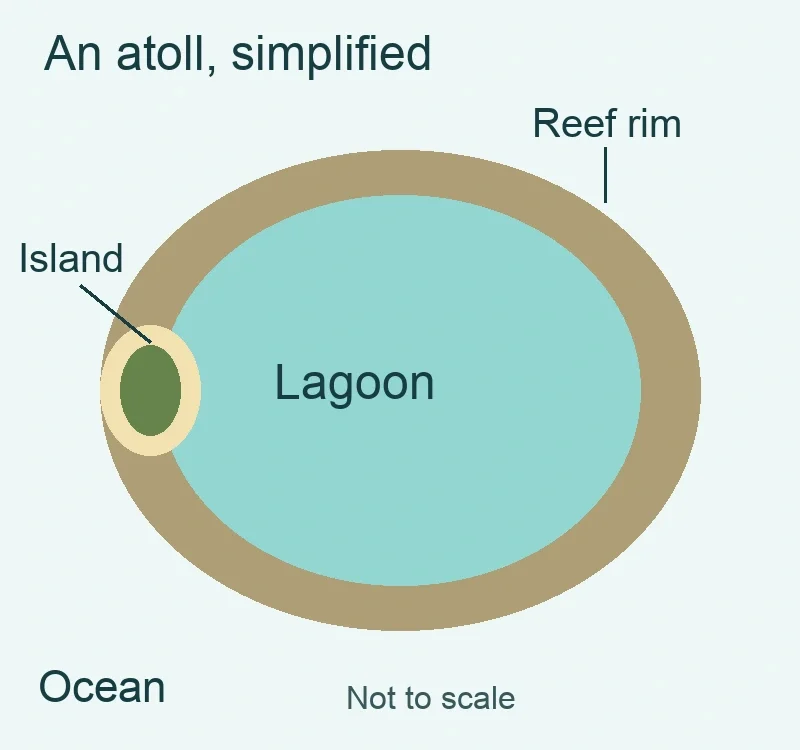
Diagram by BharatQuests, based on NOAA's description of reef forms. It shows a generic atoll, not a map of a Lakshadweep island; not to scale.
How can animals help build land?
A coral colony contains many tiny animals called polyps. Hard, or stony, corals produce rigid skeletons of calcium carbonate, which form the reef's framework. NOAA distinguishes these reef-building hard corals from soft corals, which do not build the same rigid framework.
The dry island is not simply living coral sticking out of the sea. Pieces of reef break into sediment, which moving water can gather into islands. Shell-producing organisms contribute too.
A 2024 study of Lakshadweep island change examined sediments collected along Bangaram's shoreline. Coral fragments and mollusc shells dominated those samples, with foraminifera—small shelled organisms—also present. So the sand in a “coral island” can come from several kinds of marine life. Those samples describe Bangaram’s shoreline, not every Lakshadweep island.
Why can reefs grow here?
NOAA explains that many reef-building stony corals live in warm, sunlit shallow water. Deep-sea corals exist too, but they grow in different conditions from these tropical reefs.
Lakshadweep's islands and atolls lie along a north–south undersea ridge, as NASA's Earth Observatory describes. The beaches sit on a much larger submerged landscape; only a small area rises above sea level.
How does an atoll get its ring?
A classic explanation starts with a reef growing around a volcanic island. As the island slowly subsides, the reef can continue growing upward. A lagoon separates the reef from the remaining land; if the central island sinks below the surface, the reef can remain as a ring around the lagoon. NOAA illustrates this sequence from fringing reef to barrier reef to atoll.
This general model explains how a reef can remain near the surface while its older foundation lies far below it. It is not a precise reconstruction of how each Lakshadweep island formed. In that model, the dry land forms from accumulated reef-derived sediment rather than an exposed mountain summit.
Why the living reef still matters
Lakshadweep's reefs continue to supply island-building sediment and reduce the force of ocean waves. The Nature Conservation Foundation's field research programme studies the balance between processes that build calcium-carbonate structure and those that erode it. Both reef growth and sediment movement matter to the islands' future.
The 2024 shoreline study also shows that islands can change shape as sediment moves. A beach may erode in one place while material accumulates elsewhere. An island's outline on a map is therefore a snapshot of a moving system.