Why does the monsoon reach Kerala first?
The monsoon is a seasonal shift in India's winds, not a storm. Kerala is where the moist south-westerly flow first meets the mainland, and IMD declares onset by published tests.

Why India Looks This Way
On 4 June 2026 the India Meteorological Department (IMD) announced that the southwest monsoon had "set in over Kerala", three days after the normal date of 1 June. The date shifts from year to year, but IMD's normal calendar always runs in the same order: Kerala on 1 June, Mumbai on 11 June, Delhi on 27 June and the whole country by 8 July. Why does the monsoon reach Kerala first?
What is the short answer?
The monsoon is a seasonal shift in India's winds, not a storm that sets off from one place. In summer the wind over the Arabian Sea blows from the south-west, carrying moisture from the Indian Ocean towards the land. Kerala is where that flow first meets the Indian mainland, and just behind the coast the Western Ghats force the air upward, which produces rain. IMD declares the "onset" when rainfall, wind and cloud measurements over Kerala and the sea beside it all agree.
"First" here means first on the mainland: over the Andaman Sea the monsoon normally arrives earlier, on 22 May.
Where does the monsoon wind come from?
In the northern summer the land heats up and the air above northern India becomes a zone of low pressure. NCERT's Class 11 geography text explains that by early June this low pressure is strong enough to draw in the south-east trade winds from the southern hemisphere. They cross the equator, are turned to the right by the Earth's rotation and become south-westerly winds that pass over warm ocean and pick up moisture (NCERT, India: Physical Environment, ch. 4).
IMD's monsoon FAQ describes the same flow from the Indian Ocean side. A fast, low-level current called the Somali jet moves from east Africa into the Arabian Sea in May and reaches India's west coast in June. Either way, the monsoon arrives from the south-west, across open sea.
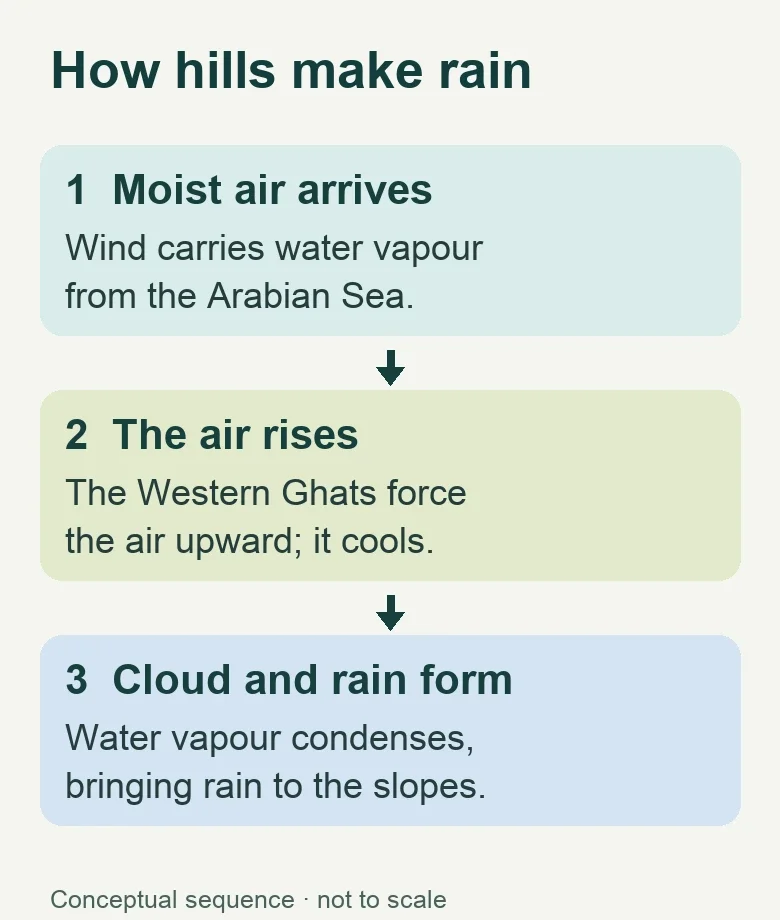
Diagram by BharatQuests. Mechanism described by NCERT and IMD.
Why does the Kerala coast come first?
Look at the geography from the wind's point of view. The air travels north-east across the Arabian Sea, and Kerala lies at the south-western end of the peninsula, on the coast facing the oncoming wind. Its shoreline is the first stretch of the mainland the moist air reaches.
The hills behind the coast then turn that moisture into rain. Air that meets a mountain wall has to rise, and rising air cools, so its water vapour condenses into cloud and rain. NCERT says the windward slopes of the Western Ghats and the coastal plain receive very heavy rainfall, which it puts at 250 to 400 cm, while the land east of the crest gets far less. IMD's FAQ gives Kerala's long-period average rainfall as 556 mm in June and 659 mm in July. We trace the dry side in Why is it drier east of the Western Ghats during the southwest monsoon?
IMD's onset rule also looks to the south-west: its wind and cloud tests are applied to boxes over the south-eastern Arabian Sea, between 5 and 10 degrees north. From Kerala the monsoon advances north, usually in surges rather than at a steady pace.
How does IMD decide that the monsoon has arrived?
IMD uses published criteria for Kerala, adopted in 2016. After 10 May, if at least 60% of 14 listed stations report 2.5 mm of rain or more for two days in a row, onset can be declared on the second day. The 14 stations run from Minicoy and Amini in the islands to Mangalore in the north, and include Thiruvananthapuram, Kochi, Kozhikode and Kannur. With all 14 reporting, 60% works out to at least 9 stations.
Rain alone is not enough. IMD also requires westerly winds up to about 600 hPa, roughly four kilometres above the surface, and a westerly wind of 15 to 20 knots at a low level (925 hPa) over the south-eastern Arabian Sea. The last test uses outgoing longwave radiation (OLR), the heat leaving the Earth for space: a reading below 200 W/m² in that sea box points to deep, thick cloud. In its 2026 announcement IMD cited these same signs: more cloud over the south-eastern Arabian Sea, westerlies up to 4.5 km and widespread rain over Kerala.
Together the tests keep one wet spell from being mistaken for the season. They apply only to Kerala; for other regions, IMD's FAQ says it declares onset operationally, in a more subjective way, looking for a sharp rise in rainfall that lasts a few days.
Why does the date move from year to year?
Onset is defined by what the atmosphere does, not by the calendar. IMD forecasts it each year with a stated error of plus or minus four days.
| Year | IMD forecast | Actual onset over Kerala |
|---|---|---|
| 2020 | 5 June | 1 June |
| 2021 | 31 May | 3 June |
| 2022 | 27 May | 29 May |
| 2023 | 4 June | 8 June |
| 2024 | 31 May | 30 May |
| 2025 | 27 May | 24 May |
| 2026 | 26 May | 4 June |
Sources: IMD, 10 May 2025 (forecasts 2020 to 2025; actual 2020 to 2024); IMD releases for 24 May 2025, 15 May 2026 and 4 June 2026.
In 2025 the monsoon reached Kerala on 24 May, eight days early. In 2023 it arrived on 8 June, seven days late. Six of these seven forecasts fell inside the four-day window; the exception was 2026, when onset came nine days after IMD's 15 May forecast date of 26 May. IMD's season report acknowledges that the forecast was early.
What does the onset date tell you?
It marks when the season's winds and rain have set in over Kerala. It does not say how much rain the season will bring, or when the rest of India will get its first rain. In 2026 the onset was three days late, yet the monsoon covered the whole country on 9 July, one day after the normal date. IMD's season report does record advance over Maharashtra, Gujarat, Madhya Pradesh, Chhattisgarh and Odisha running about 7 to 10 days behind schedule (IMD). A late start in Kerala did not mean a late finish.
So the Kerala date is a first marker for anyone planning around the monsoon; local forecasts decide what happens in a given district. IMD's calendar also has an end, covered in What does southwest monsoon withdrawal mean in India?
Kerala or Keralam?
The state's name changed in law in 2026. The Kerala (Alteration of Name) Bill, 2026 provides that the State of Kerala "shall be known as the State of Keralam", and Onmanorama reports that the Home Ministry brought the Act into force on 25 August 2026. IMD's 4 June 2026 onset release, issued before that date, uses "Kerala", and this article follows the wording of the IMD material it cites.
Cover photo: Nagesh Jayaraman, Wikimedia Commons, licensed CC BY 2.0. Cropped. It shows cloud over forested Western Ghats slopes near Meenmutty falls, photographed on 4 October 2009. It is a monsoon-season landscape, not a photograph of an onset.
